

Aging Skin Needs Stability Over New Products
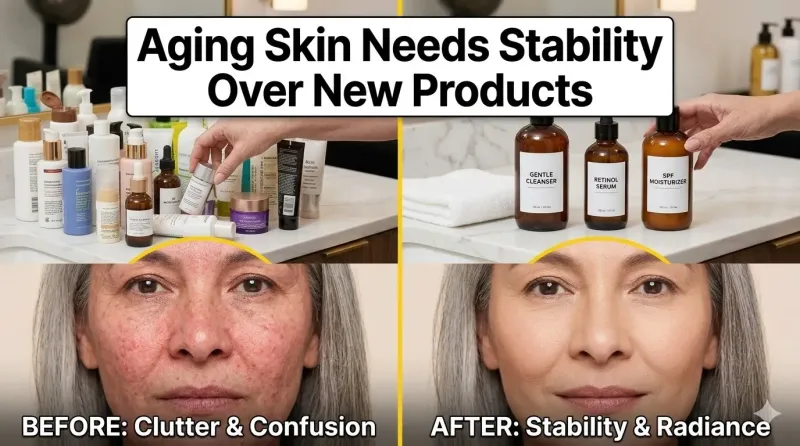
If you have ever stood in the skincare aisle, surrounded by serums, creams, and treatments promising to erase fine lines, restore firmness, and turn back time, you know how tempting it is to reach for the newest launch. The beauty industry thrives on innovation, constantly introducing breakthrough ingredients, advanced technologies, and viral routines that promise dramatic transformations for aging skin. But here is a truth that dermatologists and skincare experts understand but rarely emphasize: aging skin does not need more products. It needs stability.
Switching anti-aging products frequently might feel like taking proactive control of your skin's future, but it often does more harm than good. Mature skin is more delicate, slower to heal, and more sensitive to disruption than younger skin. When you introduce a new retinol, peptide serum, or exfoliating acid every few weeks, you never give your skin the chance to adapt, repair, or build resilience under a stable regimen. The result? Increased sensitivity, barrier compromise, wasted money, and skin that seems stuck in a cycle of irritation and disappointment.
This guide explores why consistency is the most powerful yet underrated secret to healthy aging skin. We will break down the science of how mature skin responds to care, explain why product-hopping undermines your anti-aging goals, and provide a practical framework for building a simple, effective routine that delivers real, lasting results. Whether you are noticing fine lines, loss of firmness, dryness, or just confusion about what actually works for mature skin, you will find evidence-based strategies to help you stop chasing trends and start seeing progress.
Because healthy aging skin is not about having the most expensive or newest products. It is about giving your skin the time, gentleness, and stability it needs to flourish at every stage of life.
The Science of Aging Skin Why Stability Matters More Than You Think
To understand why consistency beats novelty in mature skincare, you first need to understand how aging skin changes and responds to external care.
Skin renewal slows with age
As we age, our skin's natural cell turnover rate decreases. In our twenties, skin cells renew approximately every 28 days. By our forties and fifties, this process can slow to 40-60 days or longer. This means that any change you make to your routine—whether switching to a new retinol, adding a peptide serum, or trying a different moisturizer—will take significantly longer to show visible results. If you switch products before this extended cycle completes, you interrupt the process and never allow your skin to fully benefit from any single approach.
The skin barrier becomes more vulnerable
Mature skin produces less natural oil and has a thinner, more fragile barrier. This makes it more prone to dryness, irritation, and sensitivity. Products work by supporting, protecting, and reinforcing this barrier. This protective effect builds over time with consistent use of gentle, nourishing ingredients. Frequently changing products means you are constantly resetting this protective layer, leaving mature skin vulnerable to environmental stressors and moisture loss.
Collagen and elastin production decline
Starting in our mid-twenties, collagen production decreases by about one percent per year. Elastin, which gives skin its bounce, also declines. Anti-aging ingredients like retinoids, peptides, and vitamin C work by stimulating collagen production and protecting existing collagen from damage. These benefits accumulate gradually with consistent, long-term use. Switching products frequently interrupts this cumulative effect.
Featured snippet answer: Why is consistency important for aging skin care? Aging skin renews more slowly and has a more fragile barrier, so it needs extended time to respond to care. Consistent routines allow anti-aging ingredients to build cumulative benefits, support barrier health, and show measurable results. Frequently switching products interrupts this process and can increase sensitivity and irritation.
The Hidden Costs of Product-Hopping for Mature Skin
It is easy to believe that trying a new anti-aging product is a low-risk experiment. But for mature skin, the cumulative effects of frequent switching can be particularly significant.
You never know what actually works
If you use a retinol serum for three weeks, see no dramatic change in fine lines, and switch to another, you will never know if the first product would have delivered results with more time. Anti-aging skincare is not instant. Many effective ingredients—like retinoids for cell turnover, peptides for firmness, or niacinamide for barrier support—require consistent use over 8-12 weeks to show visible improvement in mature skin.
Ingredient conflicts and barrier disruption
Different anti-aging products contain different active ingredients, pH levels, and formulations. Switching frequently can cause these ingredients to interact unpredictably on mature skin. For example, using a strong exfoliating acid one week and a new retinol the next might overwhelm your skin's barrier, leading to redness, peeling, or increased sensitivity. Consistency allows you to understand how your mature skin responds to a specific combination of ingredients and adjust gently.
Wasted money and emotional fatigue
The average consumer spends significant money on anti-aging products that go half-used. Beyond the financial cost, constantly researching, buying, and testing new products creates mental exhaustion. This decision fatigue can make skincare feel like a stressful chore rather than a nurturing form of self-care—especially when results do not appear as quickly as hoped.
Increased sensitivity and irritation
Mature skin is more reactive and slower to heal. Introducing new actives frequently can trigger irritation, redness, or contact dermatitis. A consistent, gentle routine gives mature skin time to stabilize, build tolerance to actives, and maintain a healthy microbiome.
People Also Ask: How long should I use an anti-aging product before deciding if it works? For mature skin, allow at least 8-12 weeks of consistent use before evaluating results. Skin renewal slows with age, and benefits like improved firmness, reduced fine lines, or better texture take time to become visible. If you experience persistent irritation or adverse reactions, discontinue use and consult a dermatologist.
What a Consistent Routine for Aging Skin Actually Looks Like
Consistency does not mean using the exact same products forever. It means building a stable foundation and making intentional, gradual adjustments based on your skin's evolving needs.
Step 1 Understand your mature skin type and concerns
Before choosing products, assess your skin
- Texture and firmness: Is skin losing elasticity or showing sagging?- Hydration level: Is skin dry, dehydrated, or combination?- Sensitivity: Does skin react easily to new products or environmental changes?- Primary concerns: Fine lines, deep wrinkles, dullness, uneven tone, or loss of firmness
This clarity helps you choose products that address your specific needs rather than chasing every new trend.
Step 2 Build a simple, stable core routine
A consistent routine for aging skin does not require ten steps. Start with these essentials
- Gentle cleanser: A cream or milky formula that cleans without stripping natural oils- Targeted treatment: One active ingredient like retinol, peptide serum, or vitamin C (use consistently)- Hydrating moisturizer: Rich in ceramides, hyaluronic acid, or natural oils to support the barrier- Daily sunscreen: Broad-spectrum SPF 30+ to protect against further photoaging
Stick with this core for at least 8-12 weeks before considering changes.
Step 3 Track subtle progress, not dramatic transformation
Instead of expecting overnight erasure of wrinkles, look for gradual signs of improvement
- Skin feels softer and more comfortable after cleansing- Fine lines appear less pronounced in certain lighting- Makeup applies more smoothly- Skin tone looks more even and radiant- Less irritation or reactivity to environmental changes
Take monthly photos in consistent lighting to track changes objectively.
Step 4 Adjust intentionally, not impulsively
If after 12 weeks you feel a product is not meeting your needs, make one change at a time. For example, if your skin feels dry, try a richer moisturizer before overhauling your entire routine. This methodical approach helps you identify what truly works for your unique skin.
Featured snippet answer: What is a simple consistent routine for aging skin? Start with a gentle cream cleanser, one targeted anti-aging treatment like retinol or peptides, a rich moisturizer with barrier-supporting ingredients, and daily broad-spectrum SPF 30+. Use these consistently for 8-12 weeks before making changes. Track subtle improvements like softer texture and more even tone rather than expecting instant wrinkle reduction.
Common Mistakes That Undermine Stability for Mature Skin
Even with good intentions, certain habits can sabotage your efforts to build a stable skincare routine for aging skin.
Mistake #1 Chasing every anti-aging trend
Social media highlights dramatic before-and-afters, but these often feature professional lighting, editing, or temporary effects. A product that works for one person's skin may not suit mature skin, which has different needs. Focus on ingredients with clinical evidence for aging skin, not viral hype.
Mistake #2 Layering too many actives at once
Using multiple serums with retinol, vitamin C, AHAs, and peptides simultaneously can overwhelm mature skin and compromise the barrier. Start with one active ingredient and master its use before considering adding another.
Mistake #3 Ignoring seasonal and hormonal changes
Skin needs can shift with seasons, menopause, or health changes. Instead of switching products entirely, adjust your routine slightly—like adding a richer moisturizer in winter or a gentle hydrating mask during hormonal fluctuations—while keeping your core routine stable.
Mistake #4 Expecting instant reversal of aging signs
Skincare for mature skin is about improvement and maintenance, not reversal. If you expect a new serum to erase deep wrinkles in one week, you will be disappointed. Set realistic expectations: look for gradual improvement in texture, tone, and comfort over weeks and months.
Mistake #5 Neglecting barrier support
Healthy aging skin starts with a strong barrier. If you focus only on actives like retinol or acids while ignoring hydration and barrier repair, you limit your skin's ability to tolerate and benefit from those actives. Include gentle, nourishing products in your consistent routine.
People Also Ask: Can switching skincare products too often damage mature skin? Yes. Frequently changing products can disrupt the skin's microbiome, cause ingredient conflicts, and prevent you from identifying what truly works. This can lead to increased dryness, sensitivity, or irritation—especially in mature skin with a naturally thinner barrier. Stick with a simple, consistent routine for at least 8-12 weeks before making changes.
How to Choose Anti-Aging Products Worth Sticking With
Consistency only works if you are using products that actually support your aging skin goals. Here is how to choose wisely.
Look for evidence-backed ingredients for mature skin
Prioritize products with ingredients that have scientific support for aging skin
- For cell renewal and fine lines: Retinoids (retinol, retinaldehyde), bakuchiol- For firmness and elasticity: Peptides, growth factors, collagen-boosting ingredients- For hydration and barrier support: Ceramides, hyaluronic acid, squalane, natural oils- For brightness and even tone: Vitamin C (stable forms), niacinamide, licorice root extract- For protection: Antioxidants (vitamin E, ferulic acid), broad-spectrum sunscreen
Avoid products with long lists of trendy ingredients but no clear primary benefit for your specific concerns.
Check formulation quality and gentleness
A well-formulated anti-aging product balances efficacy with gentleness. Read reviews from users with similar mature skin types. Look for brands that disclose ingredient concentrations and avoid harsh sulfates, high concentrations of drying alcohols, or unnecessary fragrances if you have sensitive mature skin.
Start with samples or travel sizes
Before committing to a full-size anti-aging product, try a sample or travel size. This lets you test compatibility without significant investment. If your mature skin responds well, you can confidently purchase the full size and incorporate it into your consistent routine.
Consider your lifestyle and routine simplicity
The best routine is one you can maintain consistently. If you have a busy schedule, choose multi-tasking products (like a moisturizer with SPF and antioxidants) or low-maintenance formulas. Consistency is easier when your routine fits seamlessly into your life.
Patience and Progress Setting Realistic Expectations for Mature Skin
One of the biggest reasons people abandon consistent routines is impatience. Understanding realistic timelines helps you stay the course with aging skin.
Typical timelines for anti-aging results in mature skin
- 2-4 weeks: Improved hydration, softer texture, initial glow- 6-8 weeks: Noticeable improvement in skin comfort, reduced dryness, better product absorption- 8-12 weeks: Visible improvement in fine lines, more even tone, improved firmness- 3-6 months: Significant improvement in overall skin health, resilience, and appearance
These timelines assume consistent use of appropriate products, gentle handling, and daily sun protection.
Signs your consistent routine is working for aging skin
- Skin feels more comfortable and less tight after cleansing- Makeup applies more smoothly and lasts longer- Fine lines appear softer, especially in good lighting- Skin tone looks more even and radiant- Less reactivity to environmental changes or new products- New skincare products are tolerated better
Celebrate these small wins—they are proof that consistency and patience are paying off.
When to reconsider your mature skin routine
While patience is key, there are valid reasons to adjust
- Persistent irritation, redness, or burning that does not resolve- No visible improvement after 12 weeks of consistent, appropriate use- Major life changes (menopause, medication, significant stress) that alter skin needs- Desire to address a new concern (like age spots or loss of firmness)
Make changes one at a time and document the results over another 8-12 week period.
People Also Ask: How do I know if an anti-aging product is working for mature skin? Look for subtle improvements over 8-12 weeks: softer texture, better hydration, more even tone, or improved comfort. Take monthly photos in consistent lighting to track progress objectively. If you see no change or experience persistent irritation after consistent use, consider adjusting your routine with professional guidance.
Building Long-Term Skin Health for Aging Beyond Products
Consistent skincare for mature skin extends beyond the products you use. These lifestyle habits support lasting skin health and enhance the benefits of your routine.
Gentle handling and protection
- Use lukewarm water, not hot, to avoid stripping natural oils- Pat skin dry gently with a soft towel; never rub- Apply products with gentle upward motions to avoid tugging delicate skin- Protect skin from sun exposure with hats, sunglasses, and daily SPF
Nutrition and hydration from within
- Eat protein-rich foods to support collagen production- Include omega-3 fatty acids, antioxidants, and vitamins C and E for skin health- Stay well-hydrated—dehydration can make fine lines more visible- Limit excessive alcohol and sugar, which can accelerate skin aging
Stress management and sleep
- Chronic stress elevates cortisol, which can break down collagen and impair skin barrier function- Practice relaxation techniques like meditation, gentle yoga, or deep breathing- Prioritize quality sleep, as skin repair and renewal peak during rest
Professional guidance when needed
- Consult a dermatologist for personalized advice on ingredients and treatments- Consider professional treatments like gentle chemical peels or laser therapy as complementary support, not replacements for daily care- Get regular skin checks to monitor for age-related changes or concerns
Frequently Asked Questions About Aging Skin Consistency
Why does my mature skin look worse when I start a new anti-aging routine?
This is often an adjustment or "purge" period. As mature skin adapts to new active ingredients like retinol, you may experience temporary dryness, flaking, or mild irritation. Stick with a gentle, consistent routine for 6-8 weeks to allow your skin to stabilize. If irritation persists or worsens, discontinue use and consult a dermatologist.
Can I use retinol every night as I age?
For many people with mature skin, nightly retinol use can be too irritating. Start with 2-3 times per week and gradually increase frequency as tolerated. Always follow with a rich moisturizer and use daily sunscreen. If your skin feels sensitive, buffer retinol by applying moisturizer first, then retinol.
How often should I change my anti-aging skincare products?
There is no need to change products regularly if your current routine is working and your skin is healthy. Only switch if your skin needs change (due to season, health, or new concerns) or if a product causes persistent irritation. When you do switch, allow 8-12 weeks to evaluate results before making another change.
Does consistency mean I can never try new anti-aging products?
No. Consistency means having a stable core routine. You can still experiment with new products occasionally—just introduce one at a time, patch test first, and give it adequate time (8-12 weeks) to work before deciding to keep or replace it.
What if my mature skin needs change with seasons or hormones?
Seasonal and hormonal adjustments are normal for aging skin. Instead of overhauling your routine, make small, targeted tweaks: add a richer moisturizer or facial oil in winter, use a gentle hydrating mask during menopause-related dryness, or incorporate a brightening serum if sun spots appear. Keep your core products consistent while adapting to changing needs.
Is it too late to start a consistent skincare routine for aging skin?
It is never too late. While starting earlier provides cumulative benefits, mature skin can still improve significantly with consistent, appropriate care. Focus on gentle cleansing, targeted actives, barrier support, and daily sun protection. Improvements in texture, tone, and comfort are achievable at any age.
Conclusion Your Aging Skin Deserves Patience, Not Products
In a world that celebrates the new and the novel, choosing consistency for your mature skincare is a quiet act of wisdom and self-respect. Your aging skin does not need the latest viral serum or the most expensive treatment. It needs time, gentleness, and a routine that honors its natural rhythm and evolving needs.
Remember the essentials
- Aging skin renews more slowly and has a more fragile barrier—consistency allows products to work cumulatively- Build a simple core routine with gentle cleansing, one targeted active, rich hydration, and daily SPF- Stick with your routine for at least 8-12 weeks before evaluating results- Track subtle progress like improved comfort and texture, not dramatic overnight transformation- Adjust intentionally based on your skin's needs, not marketing trends- Support skin health from within with nutrition, gentle handling, stress management, and sun protection
The next time you feel tempted to buy another new anti-aging product, pause. Ask yourself: Have I given my current routine enough time to work? Is my skin asking for something new, or am I just responding to clever marketing? Often, the most powerful choice is to stay the course.
Your healthiest, most radiant aging skin is not found in a bottle. It is cultivated through patience, consistency, and compassionate care. Trust the process. Honor your skin's timeline. And watch as steady, intentional care transforms not just your skin's appearance, but your relationship with aging itself.
Start today. Choose stability. Your skin will thank you for years to come.