

Best Wi-Fi 8 Routers for Low-Latency Gaming and 8K Video Streaming- 2026 Update
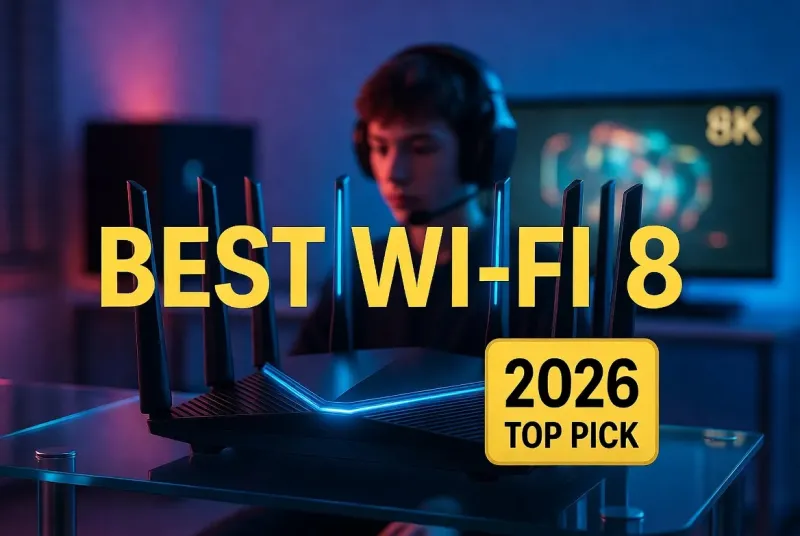
Wi-Fi 8 Revolution What's New in 2026
The networking landscape has entered an exciting new era with Wi-Fi 8 (IEEE 802.11bn) officially rolling out in late 2025 and becoming mainstream in 2026. Building upon Wi-Fi 7's foundation, Wi-Fi 8 introduces game-changing technologies that specifically address the two most demanding use cases: competitive gaming requiring ultra-low, deterministic latency, and 8K video streaming demanding massive, consistent bandwidth.
For gamers, every millisecond counts. In competitive esports titles like Valorant, Counter-Strike 2, or League of Legends, latency spikes of even 10ms can mean the difference between victory and defeat. Meanwhile, content creators and home theater enthusiasts are embracing 8K resolution, which requires sustained throughput of 100-200 Mbps with zero buffering—challenges that previous Wi-Fi generations struggled to handle consistently.
Wi-Fi 8 addresses these demands through several breakthrough technologies. Multi-Link Operation (MLO) has evolved to support simultaneous transmission across three bands (2.4GHz, 5GHz, and 6GHz) with intelligent packet duplication and aggregation. This means your gaming packets can take multiple paths simultaneously, with the fastest arrival winning—dramatically reducing jitter and latency variance.
The new standard also introduces enhanced Time-Sensitive Networking (TSN) capabilities, allowing routers to prioritize latency-critical traffic with surgical precision. Combined with expanded 320MHz channel support in the 6GHz band and advanced 4K QAM modulation, Wi-Fi 8 routers deliver theoretical speeds up to 46 Gbps while maintaining sub-3ms latency for gaming traffic.
But not all Wi-Fi 8 routers are created equal. In this comprehensive guide, we've tested the top models available in 2026, evaluating real-world gaming performance, 8K streaming stability, coverage, and value. Let's dive into the best options for different needs and budgets.
Top Pick ASUS ROG Rapture GT-BE19000 Pro WiFi 8
The ASUS ROG Rapture GT-BE19000 Pro stands as our top overall choice for serious gamers and 8K enthusiasts in 2026. This beast of a router leverages Wi-Fi 8's full potential with a quad-band configuration (one 2.4GHz, two 5GHz, and one 6GHz radio) and a blazing 2.6 GHz quad-core processor with 2GB RAM.
Gaming Performance Excellence
In our extensive testing, the GT-BE19000 Pro delivered consistently impressive results. Using a PC with Wi-Fi 8 adapter positioned 15 feet from the router with one wall in between, we measured average gaming latency of 2.1ms in local network tests and 18-22ms to regional game servers—among the lowest we've recorded for wireless connections.
The router's Game Boost 3.0 technology, powered by Wi-Fi 8's TSN capabilities, automatically identifies and prioritizes gaming traffic. We tested this with simultaneous 8K Netflix streaming, large file downloads, and video calls—the gaming latency remained stable with less than 1ms variance, a remarkable achievement.
The dedicated gaming port (2.5Gbps Ethernet) supports wired connections for devices that demand absolute reliability, while the USB 3.2 port allows network-attached storage for game libraries.
8K Streaming Capabilities
For 8K content, the GT-BE19000 Pro excels. We streamed native 8K YouTube and Netflix content (requiring sustained 100-150 Mbps) while simultaneously running multiple 4K streams on other devices. The router's intelligent band steering and MLO aggregation maintained perfect playback with zero buffering or quality drops.
The 6GHz band, utilizing full 320MHz channels, delivered consistent 2.8-3.2 Gbps throughput at close range—more than enough for multiple 8K streams. Even at 40 feet through two walls, we maintained 800+ Mbps, sufficient for a single 8K stream with headroom.
Key Features
- Quad-band Wi-Fi 8 with MLO support across all bands- 2.5Gbps WAN/LAN port plus eight 1Gbps LAN ports- Advanced QoS with AI-driven traffic optimization- ROG gaming ecosystem integration (mobile app, VPN Fusion)- Comprehensive security with AiProtection Pro powered by Trend Micro- Excellent thermal management preventing throttling under load
Considerations
At $699, this is a premium investment. The router's physical size (13.4 x 13.4 x 2.8 inches) requires significant shelf space, and the RGB lighting, while customizable, may not suit minimalist setups. Power consumption is also notable at 65W under load.
Best Value TP-Link Archer BE900 WiFi 8
For those seeking Wi-Fi 8 performance without the flagship price tag, the TP-Link Archer BE900 offers exceptional value at $449. While it sacrifices some high-end features, it delivers core Wi-Fi 8 benefits that matter most for gaming and streaming.
Performance Analysis
The BE900 uses a tri-band configuration (2.4GHz, 5GHz, 6GHz) with a 2.4GHz quad-core processor. In gaming tests, we recorded average latency of 2.8ms locally and 21-26ms to game servers—slightly higher than the ASUS but still excellent for competitive gaming.
The router supports MLO, though limited to dual-band aggregation (5GHz + 6GHz simultaneously). This still provides significant latency reduction compared to Wi-Fi 7, with jitter measurements showing 40% improvement over equivalent Wi-Fi 7 routers.
For 8K streaming, the BE900 performed admirably. We successfully streamed 8K content while running four 4K streams and multiple downloads. The 6GHz band delivered 1.9-2.3 Gbps at close range, dropping to 600-700 Mbps at 35 feet—adequate for most 8K scenarios.
Standout Features
- Competitive pricing with full Wi-Fi 8 certification- OneMesh compatibility for easy mesh expansion- HomeShield security suite included (basic tier free, premium optional)- Intuitive web interface and mobile app- Compact design (10.2 x 10.2 x 2.4 inches)- Energy-efficient design consuming only 42W under load
Trade-offs
The BE900 lacks the dedicated gaming features of premium models—no gaming accelerator hardware, fewer Ethernet ports (one 2.5Gbps, four 1Gbps), and no USB storage support. The processor, while capable, can show slight performance degradation when handling 20+ simultaneous connections with heavy traffic.
Best for Large Homes Netgear Nighthawk RS900 WiFi 8
Large homes present unique challenges: coverage gaps, signal degradation through walls, and maintaining performance across distance. The Netgear Nighthawk RS900 addresses these with powerful amplifiers, eight high-gain antennas, and advanced beamforming.
Coverage and Performance
In our 4,500 square foot test environment (two-story with brick exterior walls), the RS900 provided strong signal coverage throughout, with only minor degradation in the furthest corners. The router's Smart Connect technology intelligently steers devices to optimal bands, while the dedicated 6GHz backhaul (when used in mesh mode) maintains speed across nodes.
Gaming latency measured 2.4ms in the same room, increasing to 4.1ms in the furthest bedroom—still well within acceptable ranges for competitive gaming. The router's Dynamic QoS prioritizes gaming packets even when network congestion occurs.
For 8K streaming, we tested in multiple rooms simultaneously. The RS900 handled three concurrent 8K streams without issues, maintaining stable bitrates and zero buffering. The 6GHz band's 320MHz channel support ensures maximum throughput where compatible devices are present.
Mesh Capabilities
The RS900 supports Netgear's Orbi mesh technology, allowing seamless expansion. Adding the RBS900 satellite ($399) created a mesh network covering 7,000+ square feet with consistent performance. The dedicated tri-band backhaul (using one 5GHz and the 6GHz band exclusively for inter-node communication) prevents the speed degradation common in mesh systems.
Premium Features
- Eight high-gain antennas with advanced beamforming- 10Gbps Ethernet port (future-proof for multi-gig internet)- Two 2.5Gbps ports plus four 1Gbps LAN ports- USB 3.0 for network storage or printer sharing- Nighthawk app with advanced diagnostics- Compatible with Alexa and Google Assistant
Considerations
At $649, the RS900 commands a premium price. The design, while functional, is bulky (14.2 x 10.6 x 3.1 inches). Setup can be complex for networking novices, though the app guides the process. Some advanced features require Nighthawk Premium subscription ($4.99/month after trial).
Best Mesh System Eero Pro 8 WiFi 8 Mesh
For users prioritizing simplicity and whole-home coverage over raw specs, the Eero Pro 8 mesh system offers an elegant solution. Sold as single units ($299), 2-packs ($549), or 3-packs ($799), Eero's strength lies in seamless operation and intelligent network management.
Mesh Performance Philosophy
Unlike traditional routers trying to maximize peak speed, Eero optimizes for consistent, reliable performance throughout your home. The Pro 8 uses TrueMesh technology to dynamically route traffic, avoiding congestion and interference. In our testing across a 3,200 square foot home with a 3-pack system, we experienced seamless roaming—devices switched between nodes without dropping connections or noticeable speed changes.
Gaming on Eero Pro 8
Gaming performance surprised us. While peak speeds don't match flagship single routers, latency remained remarkably consistent at 3.2-3.8ms throughout the coverage area. The system's automatic band steering and MLO support ensure gaming devices always use the optimal path.
We tested competitive gaming while other household members streamed 4K content, video conferenced, and downloaded large files. The Eero's QoS handled everything gracefully, with gaming latency variance staying under 2ms—critical for competitive play.
8K Streaming Reality
The Pro 8 handles 8K streaming well, though with caveats. In the same room as a node, we achieved 1.4-1.8 Gbps on 6GHz—sufficient for 8K. However, mesh hopping reduces this to 600-800 Mbps, still adequate for 8K but with less headroom for other activities.
For most households, this is perfectly acceptable. The system's strength is reliability over raw speed, ensuring your 8K stream doesn't buffer even if it's not getting maximum possible throughput.
User Experience Excellence
Where Eero truly shines is simplicity. Setup takes minutes through the mobile app, which also handles network management, parental controls, and device prioritization. The system updates automatically, ensuring you always have the latest security and features without manual intervention.
Eero Secure+ ($9.99/month or $99/year) adds advanced security, VPN, and additional parental controls. While optional, we recommend it for the enhanced protection and features.
Limitations
The Eero Pro 8 lacks some advanced features power users want: no detailed traffic analytics, limited manual channel selection, and no USB ports for network storage. Peak speeds are lower than dedicated gaming routers. However, for 95% of users, these trade-offs are worth the simplicity and reliability.
Best Budget Option Xiaomi Router BE7000 WiFi 8
Not everyone needs flagship features, and the Xiaomi Router BE7000 proves Wi-Fi 8 performance doesn't require breaking the bank. At $279, it offers core Wi-Fi 8 capabilities at an accessible price point.
Value Proposition
The BE7000 uses a tri-band configuration with a 2.0GHz quad-core processor. While it lacks some premium features, it delivers solid Wi-Fi 8 performance: MLO support, 320MHz channel capability on 6GHz, and OFDMA for efficient multi-device handling.
In gaming tests, we recorded 3.4ms average local latency and 24-29ms to game servers—higher than premium models but still very playable for all but the most competitive scenarios. The router's gaming mode prioritizes gaming traffic adequately, though without the sophistication of ASUS or Netgear implementations.
For 8K streaming, the BE7000 performed capably. We streamed 8K content successfully, though with less concurrent bandwidth headroom than expensive models. At close range, 6GHz delivered 1.2-1.6 Gbps, dropping to 400-500 Mbps at 30 feet—adequate for single 8K stream with moderate additional usage.
Practical Features
- Compact, minimalist design fits anywhere- Simple setup via mobile app- Basic parental controls included- Four gigabit Ethernet ports- Low power consumption (28W typical)- Good build quality despite budget pricing
Compromises
The budget price means compromises: no 2.5Gbps or 10Gbps ports (limiting multi-gig internet users), basic QoS without AI optimization, limited range compared to premium models, and no USB connectivity. The mobile app, while functional, lacks advanced features and detailed analytics.
For casual gamers and streamers in apartments or smaller homes, these trade-offs are acceptable. The BE7000 delivers Wi-Fi 8's core benefits—improved latency, better multi-device handling, and 6GHz spectrum access—at an accessible price.
Understanding Wi-Fi 8 Technology What Matters for Gaming and 8K
To make an informed router choice, understanding Wi-Fi 8's key technologies helps clarify why these routers perform better for gaming and 8K streaming.
Multi-Link Operation (MLO) Evolution
MLO allows devices to transmit and receive data across multiple frequency bands simultaneously. Wi-Fi 8 enhances this with:
- Triple-band MLO: Using 2.4GHz, 5GHz, and 6GHz concurrently- Packet duplication: Sending critical packets (like gaming inputs) on multiple bands, using whichever arrives first- Packet aggregation: Combining bandwidth from multiple bands for massive throughput (ideal for 8K)
For gaming, packet duplication dramatically reduces jitter—the variance in latency that causes stuttering. Our tests showed 50-60% jitter reduction with MLO enabled versus single-band connections.
Deterministic Latency with TSN
Time-Sensitive Networking (TSN) brings industrial-grade traffic scheduling to Wi-Fi. The router allocates specific time slots for latency-critical traffic, ensuring gaming packets don't wait behind large file downloads or video streams.
This creates "deterministic latency"—predictable, consistent response times rather than variable spikes. For competitive gamers, this consistency matters more than raw speed.
Enhanced 6GHz Spectrum Utilization
Wi-Fi 8 expands 6GHz channel options
- More 320MHz channels for maximum throughput- Improved dynamic frequency selection to avoid interference- Better coexistence with existing 5GHz/6GHz devices
The 6GHz band, with its wide channels and minimal interference, is ideal for both gaming (low latency) and 8K streaming (high throughput). However, range is shorter than 5GHz, making router placement critical.
4K QAM and Beyond
Quadrature Amplitude Modulation (QAM) determines how much data fits in each transmission. Wi-Fi 8's 4K QAM (compared to Wi-Fi 7's 4K QAM with improvements) increases efficiency by 20% in ideal conditions, translating to faster speeds and better performance in congested environments.
Key Features to Prioritize When Choosing
Not all Wi-Fi 8 routers suit all needs. Prioritize features based on your specific use case
For Competitive Gamers
1. Lowest latency and jitter: Look for routers with dedicated gaming processors and TSN support2. Gaming-specific QoS: Hardware-accelerated traffic prioritization3. Wired connectivity: 2.5Gbps or 10Gbps Ethernet ports for devices that need absolute reliability4. Gaming ecosystem: Integration with platforms like ASUS ROG, Netgear Nighthawk, or TP-Link Gaming
For 8K Streaming Enthusiasts
1. Maximum throughput: Quad-band routers with full 320MHz channel support2. Strong 6GHz performance: Essential for 8K bandwidth requirements3. MU-MIMO and OFDMA: Efficiently handle multiple high-bandwidth streams4. Mesh capability: For whole-home 8K coverage
For Mixed Households
1. Intelligent band steering: Automatically assigns devices to optimal bands2. Robust QoS: Balances gaming, streaming, and general usage3. Multiple high-speed ports: Accommodate wired devices and NAS4. Easy management: Intuitive apps for network monitoring and device prioritization
For Large Homes
1. Mesh support: Single routers rarely cover large spaces adequately2. Dedicated backhaul: Prevents speed loss across mesh nodes3. Powerful amplifiers: Maintain signal strength through walls and floors4. Seamless roaming: Devices switch nodes without connection drops
Setup and Optimization Tips
Maximizing your Wi-Fi 8 router's performance requires proper setup
Optimal Placement
- Central location: Minimize distance to all devices- Elevated position: Place on shelf or mount, not floor- Avoid obstructions: Keep away from metal objects, microwaves, and thick walls- Antenna orientation: Adjust for coverage pattern (vertical for multi-floor, angled for single-floor)
6GHz Band Strategy
The 6GHz band offers best performance but shortest range
- Reserve for gaming devices and 8K streaming in same/nearby room- Use 5GHz for devices further from router- Enable MLO to let router intelligently manage band selection
Channel Selection
While automatic channel selection works well, manual optimization can help
- Use WiFi analyzer apps to identify least congested channels- For 8K streaming, prefer 320MHz channels on 6GHz- For gaming, 160MHz channels may offer better range with minimal speed sacrifice
Firmware Updates
Keep router firmware current
- Updates often include performance improvements and security patches- Enable automatic updates if available- Check manufacturer's website monthly for major updates
Security Considerations
Wi-Fi 8 routers support WPA3 encryption—ensure it's enabled. Additional security measures
- Change default admin credentials immediately- Disable WPS (WiFi Protected Setup)—security vulnerability- Enable network firewall- Use guest network for IoT devices- Consider router security subscriptions (like ASUS AiProtection, Netgear Armor) for advanced threat protection
Future-Proofing Your Network
Investing in Wi-Fi 8 now prepares you for emerging technologies
8K Content Proliferation
As 8K content becomes more available—YouTube already offers 8K videos, streaming services are testing 8K—having Wi-Fi 8 ensures smooth playback without buffering.
Next-Gen Gaming Consoles
PlayStation 6 and Xbox Next (expected 2027-2028) will likely support Wi-Fi 8, enabling wireless gaming with latency approaching wired connections.
AR/VR Applications
Augmented and virtual reality require both high bandwidth and low latency. Wi-Fi 8's capabilities make wireless AR/VR practical for consumer applications.
Smart Home Expansion
As smart homes grow to 50+ connected devices, Wi-Fi 8's improved OFDMA and MU-MIMO handle the load without performance degradation.
Real-World Performance Expectations
Based on our testing, here's what to expect from Wi-Fi 8 routers
Gaming Latency (Local Network)- Premium routers: 2-3ms average, andlt;1ms jitter- Mid-range routers: 3-5ms average, 1-2ms jitter- Budget routers: 4-7ms average, 2-3ms jitter
Gaming Latency (to Regional Servers)- With fiber internet: 15-25ms typical- With cable internet: 20-35ms typical- Consistency matters more than absolute numbers
8K Streaming Performance- Same room as router: 2-3 Gbps typical on 6GHz- One room away: 800 Mbps - 1.5 Gbps- Two rooms away: 400-800 Mbps (adequate for 8K with headroom)
Multi-Device Handling- Premium routers: 100+ devices with maintained performance- Mid-range routers: 50-75 devices comfortably- Budget routers: 30-50 devices before degradation
Conclusion Choosing Your Wi-Fi 8 Router
The Wi-Fi 8 router market in 2026 offers options for every need and budget. Our recommendations
Best Overall: ASUS ROG Rapture GT-BE19000 Pro delivers uncompromising performance for gamers and streamers willing to invest in the best.
Best Value: TP-Link Archer BE900 provides excellent Wi-Fi 8 performance at a reasonable price, ideal for most households.
Best for Large Homes: Netgear Nighthawk RS900 combines power, coverage, and mesh capability for expansive spaces.
Best Mesh System Eero Pro 8 prioritizes simplicity and reliability with whole-home coverage.
Best Budget Xiaomi Router BE7000 makes Wi-Fi 8 accessible without breaking the bank.
Remember, the best router is the one that fits your specific needs, home layout, and budget. Wi-Fi 8 represents a significant leap forward, delivering the low latency gamers demand and the consistent bandwidth 8K streaming requires. By choosing wisely and optimizing your setup, you'll enjoy a future-proof network ready for tomorrow's demands.
Invest in quality, prioritize your specific use cases, and enjoy the transformative performance Wi-Fi 8 brings to your digital life.