
First 100 Customers Zero Ads: Ultimate Bootstrap Guide
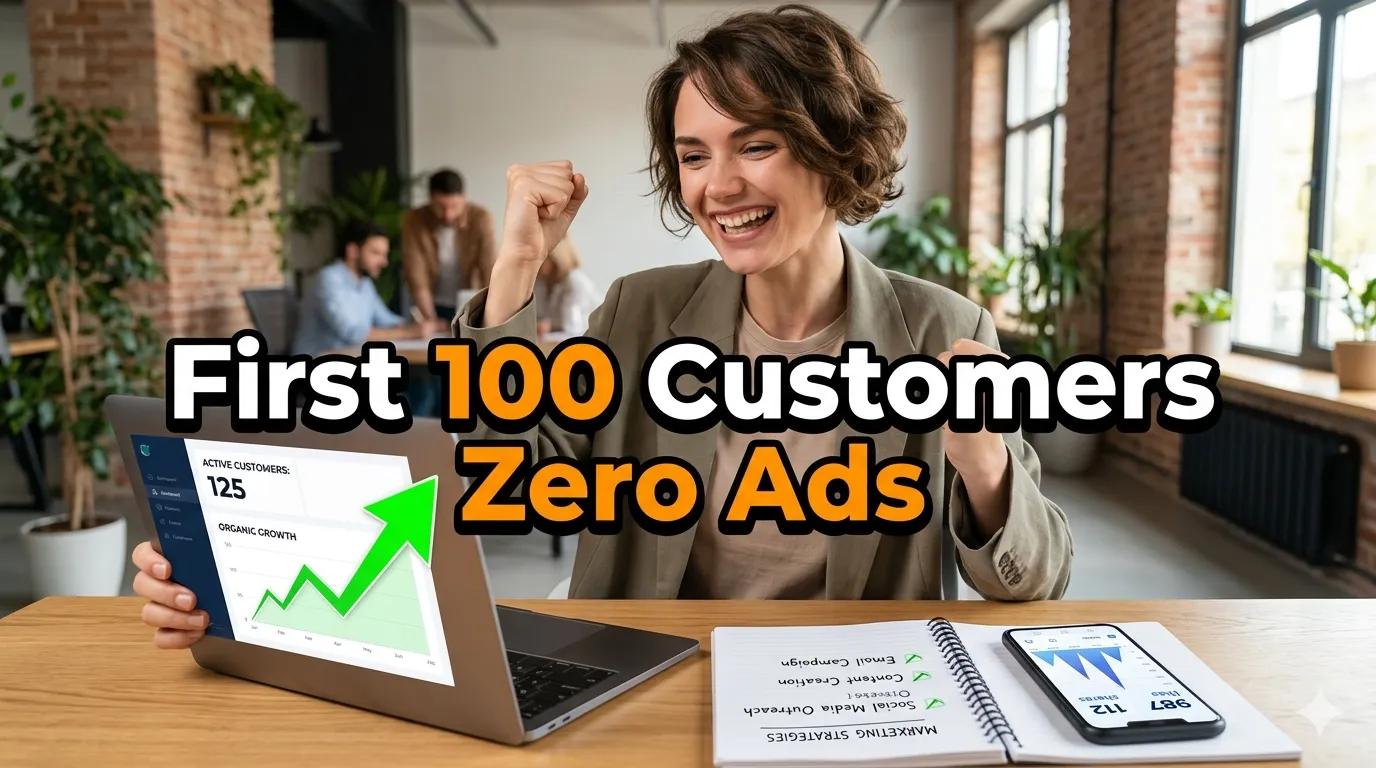
Every entrepreneur faces the same daunting challenge: how do you find your first customers when you have no budget for advertising, no established brand, and no proven track record? The truth is, some of the most successful companies in history—from Airbnb to Dropbox to Mailchimp—got their first 100 customers without spending a dime on ads. They relied on creativity, hustle, and strategic organic growth tactics that any entrepreneur can replicate.
Getting your first 100 customers without ad spend isn't just about saving money—it's about building a foundation of genuine relationships, validating your value proposition through real feedback, and developing marketing skills that will serve you long after you have a budget. These early customers become your advocates, your case studies, and your proof of concept. They're worth far more than any paid acquisition could provide.
This comprehensive guide delivers a step-by-step framework for acquiring your first 100 customers using only free, organic strategies. You'll learn how to identify and reach your ideal early adopters, leverage content and community to build trust, create irresistible offers that convert without discounts, and turn your first customers into a growth engine. Whether you're launching a SaaS product, a service business, or an e-commerce store, these proven tactics will help you build momentum without burning through capital.
Why Your First 100 Customers Matter More Than You Think
Before diving into tactics, it's essential to understand why this milestone is so critical—and why doing it organically creates lasting advantages.
The Strategic Value of Early Customers
Validation Without Guesswork:
- Real customers provide real feedback on your product, pricing, and messaging
- Early adopters help you refine your value proposition before scaling
- Organic acquisition proves people want your solution, not just that you can buy attention
Foundation for Sustainable Growth:
- Customers acquired through value-driven channels tend to have higher lifetime value
- Organic growth builds brand equity and word-of-mouth momentum
- Skills learned bootstrapping customer acquisition compound over time
Investor and Stakeholder Confidence:
- 100 organic customers is stronger proof of product-market fit than 1,000 paid users
- Demonstrates resourcefulness and marketing creativity—traits investors value
- Creates case studies and testimonials that accelerate future growth
The Mindset Shift: From Spending to Creating Value
Successful bootstrap customer acquisition requires a fundamental mindset shift:
- From: "How can I buy attention?" To: "How can I create so much value that people seek me out?"
- From: "How many ads can I run?" To: "How many genuine conversations can I have?"
- From: "What's my cost per acquisition?" To: "What's my value per interaction?"
This isn't about working harder—it's about working smarter by focusing on relationships, relevance, and remarkable value.
Phase 1: Preparation – Lay the Foundation for Organic Growth
You can't acquire customers organically if you haven't clarified who they are and why they should care. This preparation phase is non-negotiable.
Step 1: Define Your Ideal Early Adopter (Not Your "Target Market")
Why Early Adopters Are Different:
Your first 100 customers won't be your average customer. They'll be people who:
- Feel the problem you solve acutely and urgently
- Are willing to try unproven solutions
- Provide thoughtful feedback and advocate for you
- Are accessible through channels you can reach for free
Early Adopter Profile Template:
1. Demographics (basic):
   - Role/Title:
   - Industry/Context:
   - Company Size (if B2B):

2. Psychographics (critical):
   - Biggest frustration related to your solution:
   - Where they seek advice/solutions:
   - What they've tried that didn't work:
   - What would make them switch immediately:

3. Accessibility:
   - Online communities they participate in:
   - Events (virtual or local) they attend:
   - Content they consume (blogs, podcasts, newsletters):
   - People they trust for recommendations:
Action: Write this profile before doing anything else. Every tactic in this guide depends on knowing exactly who you're trying to reach.
Step 2: Craft Your "Why Now" Message
Early adopters need a compelling reason to try something new. Your message must answer: "Why should I care about this right now?"
The "Why Now" Framework:
- The Problem: Describe the specific pain point in their words
- The Cost of Inaction: What happens if they don't solve this now?
- Your Unique Approach: How is your solution different from what they've tried?
- The Immediate Benefit: What can they experience quickly (not just eventually)?
Example for a Project Management Tool:
"If you're a solo founder drowning in tasks and missed deadlines (problem), every day you delay getting organized costs you credibility with clients and momentum on your vision (cost of inaction). Unlike complex tools built for teams, [Product] is designed specifically for solo entrepreneurs who need simplicity without sacrificing power (unique approach). Get your first week of tasks organized in under 10 minutes—and finally feel in control (immediate benefit)."
Step 3: Prepare Your "Minimum Viable Offer"
Your first 100 customers aren't buying a perfect product—they're buying into a vision and a relationship. Structure your offer to reduce risk and maximize value.
Elements of a Bootstrap-Friendly Offer:
- Clear scope: Exactly what they get (avoid over-promising)
- Low barrier to entry: Free trial, pilot program, or foundational tier
- High perceived value: Bonus resources, personal onboarding, or exclusive access
- Feedback loop: Explicit invitation to shape the product
- Easy exit: No long contracts; make it risk-free to try
Pro Tip: Consider a "Founding Customer" program with special perks (lifetime discount, input on roadmap, early feature access) in exchange for feedback and testimonials. This turns customers into collaborators.
Phase 2: Outreach – Reach Early Adopters Where They Already Are
Now that you know who you're targeting and what to say, it's time to reach them. The key is to go where they already gather—don't expect them to come to you yet.
Tactic 1: Strategic Community Engagement (Not Spam)
Where to Find Early Adopters:
- Niche forums: Reddit communities, Indie Hackers, specialized Slack/Discord groups
- Professional networks: LinkedIn groups, industry associations, alumni networks
- Interest-based communities: Facebook groups, Meetup events, Twitter/X conversations
- Content platforms: Comments on relevant blogs, YouTube videos, or podcasts
The 90-10 Rule for Community Participation:
- 90% value: Answer questions, share insights, help others without mentioning your product
- 10% promotion: Only mention your solution when it's genuinely relevant to a specific problem someone raised
Example Outreach Script (Adapt to Your Voice):
Subject: Quick question about [specific problem they mentioned]

Hi [Name],

I saw your post about [specific challenge] in [Community Name] and wanted to share something that helped me when I faced the same issue.

[Share genuine, actionable advice—no pitch]

If you're still looking for solutions, I actually built [brief description of your solution] specifically for [their situation]. No pressure at all—but if you're curious, I'd love to get your thoughts as someone who's been in the trenches.

Either way, hope [specific advice] helps!

Best,
[Your Name]
Key Principles:
- Personalize every message; never copy-paste
- Lead with help, not promotion
- Make it easy to say no (reduces pressure)
- Track responses to refine your approach
Tactic 2: Content That Attracts (Not Interrupts)
Content marketing isn't about blogging for SEO—it's about creating resources so valuable that your ideal customers seek you out.
High-Impact, Low-Effort Content Formats:
- "How I Solved [Problem]" Case Studies:
- Share your own journey solving the problem your product addresses
- Include specific steps, tools, and lessons learned
- End with: "If you'd like to skip the trial-and-error, here's how I'm helping others..."
- Curated Resource Lists:
- "10 Free Tools for [Your Audience] to [Achieve Goal]"
- Include your product as #10 with honest pros/cons
- Share in communities where your audience gathers
- Answer Public Questions:
- Find questions on Quora, Reddit, or LinkedIn related to your niche
- Provide thorough, helpful answers
- Include a subtle, relevant mention of your solution if it fits
- Short-Form Video Tutorials:
- 60-second videos solving a micro-problem your audience faces
- Post on TikTok, Instagram Reels, YouTube Shorts, or LinkedIn
- End with: "If this helped, I have more tips at [link]"
Distribution Strategy (More Important Than Creation):
- Identify 3-5 places where your early adopters actively seek solutions
- Share your content there with context: "I wrote this because I saw several people asking about [topic]..."
- Engage with every comment to build relationships
- Repurpose one piece of content across multiple formats (blog post → Twitter thread → video script)
Tactic 3: Leverage Existing Relationships (The Warm Intro Advantage)
Your network is your most underutilized asset. Most entrepreneurs underestimate how many potential early customers are just one connection away.
The "Warm Intro" Framework:
- Map Your Network:
- List everyone you know: former colleagues, classmates, friends, family, acquaintances
- For each person, note: What do they do? Who do they know? What problems do they face?
- Identify Potential Introductions:
- Who in your network might need your solution?
- Who knows people who might need your solution?
- Who is well-connected in your target industry?
- Craft a Low-Pressure Ask:
Hi [Name],

Hope you're doing well! I'm working on [brief description of your solution] to help [target audience] solve [specific problem].

I remember you mentioning [relevant experience/connection]. Would you be open to:
- Trying it yourself if it's relevant to you, OR
- Introducing me to 1-2 people in your network who might find it valuable?

No pressure at all—I know you're busy. Either way, would love to catch up soon!

Best,
[Your Name]
- Make It Easy to Help:
- Include a one-paragraph description they can forward
- Offer to draft the intro email for them
- Provide a clear, low-commitment next step (e.g., "15-minute chat")
Pro Tip: Track every introduction and follow up with thank-you notes. People who help you early often become long-term advocates.
Phase 3: Conversion – Turn Interest into Commitment
Getting attention is only half the battle. Now you need to convert interest into action—without discounts or aggressive sales tactics.
Tactic 4: The "Pilot Program" Approach
Position your offer as an exclusive opportunity to shape something new, not a transaction.
Pilot Program Structure:
- Limited spots: "Accepting 20 founding customers this month"
- Clear expectations: "You'll get [benefits] in exchange for [feedback commitment]"
- Special perks: Lifetime discount, direct access to you, input on roadmap
- Easy onboarding: Simple sign-up process with personal welcome
Sample Pilot Program Pitch:
"I'm looking for 20 [target audience] to join our Founding Customer program for [Product]. As a founding customer, you'll get:
- Full access to [core features] at 50% off forever
- Monthly 1:1 check-ins with me to ensure you're getting value
- Direct input on our product roadmap
In return, I ask for honest feedback and permission to share your experience (anonymously if preferred).
If this sounds interesting, reply with 'Founding' and I'll send details. Spots are limited and filled first-come, first-served."
Why This Works:
- Scarcity creates urgency without pressure
- Collaborative framing builds partnership, not transaction
- Clear exchange of value reduces ambiguity
Tactic 5: Social Proof Before You Have Customers
You don't need 100 customers to leverage social proof—you can build credibility from day one.
Pre-Launch Social Proof Strategies:
- Expert Endorsements:
- Ask mentors, industry experts, or respected peers to review your solution
- Even a short quote like "This solves a real problem I see with my clients" adds credibility
- Feature these prominently on your landing page and outreach
- Problem Validation:
- Share screenshots of conversations where people express the problem you solve
- Quote forum posts or social media comments (with permission)
- Shows you're solving a real, validated need
- Process Transparency:
- Document your build-in-public journey: challenges, lessons, milestones
- People trust creators who are transparent about the process
- Turns your journey into compelling content that attracts early adopters
- Micro-Testimonials:
- After every helpful conversation, ask: "Would you mind if I shared that insight on my site?"
- Even small quotes like "This tip saved me hours" build momentum
Tactic 6: The "Frictionless First Step" Principle
Reduce the effort required to say yes. Every extra step costs conversions.
Optimize Your Conversion Path:
- One clear call-to-action: Don't offer multiple options; guide them to the next step
- Minimal form fields: Ask only for essential information (often just name and email)
- Immediate value: Deliver something useful immediately after sign-up (cheat sheet, audit, consultation)
- Mobile-optimized: Ensure your sign-up process works flawlessly on phones
Example Frictionless Flow:
1. Visitor reads your content or receives your outreach
2. Clicks link to simple landing page with one headline, one benefit, one button
3. Clicks "Get Early Access" → enters email → gets instant access to [valuable resource]
4. Receives automated welcome email with next step (e.g., "Book your 15-min onboarding call")
5. Completes onboarding → becomes activated customer
Test and Iterate: Track where people drop off and simplify. Even removing one form field can increase conversions by 10-20%.
Phase 4: Amplification – Turn Customers into Growth Engines
Your first customers aren't just revenue—they're your most powerful marketing channel. Systematically turn them into advocates.
Tactic 7: The "Feedback Loop" That Builds Loyalty
Early customers want to feel heard. Create structured ways to gather and act on their input.
Simple Feedback System:
- Onboarding check-in: Personal email or call after first use: "How's it going? What's one thing we could improve?"
- Weekly pulse: Short survey or message: "What's working? What's not?"
- Monthly review: Share what you've built based on their feedback
- Public acknowledgment: Credit customers who contributed ideas (with permission)
Why This Drives Growth:
- Customers who feel heard become emotionally invested in your success
- They're more likely to refer others and provide testimonials
- You build a product people actually want, reducing churn
Tactic 8: Referral Systems That Feel Natural (Not Salesy)
Referrals from happy customers are the highest-converting, lowest-cost acquisition channel. Make it easy and rewarding to share.
Bootstrap-Friendly Referral Framework:
- Timing: Ask for referrals after a "win moment" (when they've experienced clear value)
- Ask specifically: "Do you know one other [target audience] who's struggling with [problem]? I'd love to help them too."
- Make it effortless: Provide a pre-written message they can forward
- Offer genuine value: Give both referrer and referee something meaningful (extended trial, bonus feature, personal consultation)
Sample Referral Ask:
"Loved having you as one of our founding customers! If you know one other [target audience] who's dealing with [problem], I'd be grateful for an intro.
As a thank-you, I'll extend your [benefit] by a month, and they'll get [special offer].
No pressure at all—just thought I'd ask. Either way, thanks for being part of this journey!"
Tactic 9: Turn Customers into Content
Your early customers' stories are your most compelling marketing assets. Systematically capture and share them.
Low-Effort, High-Impact Customer Content:
- Micro-case studies: One-paragraph stories: "How [Customer] achieved [result] in [timeframe]"
- Quote graphics: Turn powerful testimonials into shareable social media images
- Video snippets: 30-second clips of customers sharing their experience (record via Zoom)
- "Behind the scenes" posts: Share how customer feedback shaped your product
How to Ask for Content (Without Being Pushy):
Hi [Customer],

So glad to hear [specific result] is working for you!

Would you be open to sharing a sentence or two about your experience? It would mean a lot to me and could help others facing similar challenges.

No need for anything formal—just whatever feels comfortable. And of course, I'll send it to you for approval before sharing anywhere.

Thanks for being part of this journey!

Best,
[Your Name]
Phase 5: Optimization – Double Down on What Works
Once you have momentum, focus your energy on the tactics that deliver the best results.
Track the Right Metrics (Not Vanity Metrics)
Metrics That Matter for Bootstrap Growth:
| Metric | Why It Matters | How to Track |
|---|---|---|
| Conversion rate by channel | Identify which outreach methods actually convert | Use UTM parameters or ask "How did you hear about us?" |
| Time to first value | Faster value = higher retention and referrals | Track time from sign-up to first "aha" moment |
| Referral rate | Measures customer satisfaction and advocacy | Track how many customers refer others |
| Feedback implementation rate | Shows you're listening and iterating | Count customer suggestions you've acted on |
| Organic traffic sources | Reveals which content or communities drive interest | Google Analytics, social media insights |
Avoid Vanity Metrics:
- Social media followers (unless they convert)
- Website traffic (unless it leads to sign-ups)
- "Likes" or engagement without action
The "Double Down" Framework
Every 2 weeks, review your metrics and ask:
- What's working? Which tactic brought the most qualified leads or conversions?
- Why is it working? What specific element drove results (messaging, channel, offer)?
- How can I do more of it? Can I scale this tactic without spending money?
- What's not working? What should I stop doing to free up time?
Example Optimization Cycle:
- Week 1-2: Test 3 outreach channels (Reddit, LinkedIn, niche forum)
- Review: LinkedIn messages had 3x higher conversion rate
- Week 3-4: Double down on LinkedIn: refine messaging, increase personalized outreach
- Review: Conversion rate improved by 50%; add a follow-up sequence
- Week 5-6: Systematize the winning approach; delegate or template repetitive tasks
Common Pitfalls (and How to Avoid Them)
Even with the right tactics, entrepreneurs make predictable mistakes that stall organic growth.
Pitfall #1: Trying to Reach Everyone
The Mistake: Casting a wide net to "get any customers" instead of focusing on ideal early adopters.
The Fix:
- Revisit your early adopter profile weekly
- Say no to opportunities that don't align with your target
- Remember: 100 ideal customers are better than 1,000 mismatched ones
Pitfall #2: Over-Engineering Before Validating
The Mistake: Spending months building features before talking to customers.
The Fix:
- Start conversations before your product is "perfect"
- Use no-code tools or manual processes to deliver value early
- Let customer feedback guide development, not assumptions
Pitfall #3: Ignoring Retention for Acquisition
The Mistake: Focusing solely on getting new customers while existing ones churn.
The Fix:
- Track activation and retention metrics from day one
- Personal onboarding for first 50 customers
- Ask "What almost stopped you from signing up?" to improve conversion
Pitfall #4: Being Too Polite to Ask for the Sale
The Mistake: Providing value but never clearly inviting people to become customers.
The Fix:
- Every piece of content or conversation should have a clear, low-pressure next step
- Practice your "ask" until it feels natural, not pushy
- Remember: If you believe in your solution, not offering it is doing people a disservice
Tools and Resources (All Free or Freemium)
You don't need expensive software to execute these strategies. These free tools will help you scale your efforts.
Outreach and Relationship Management
- Streak for Gmail: Free CRM inside Gmail to track conversations
- Hunter.io (free tier): Find email addresses for outreach
- Calendly (free tier): Let people book time with you without back-and-forth emails
Content Creation and Distribution
- Canva (free tier): Create professional graphics for social media and content
- CapCut or DaVinci Resolve (free): Edit short-form videos
- Buffer or Hootsuite (free tiers): Schedule social media posts
- AnswerThePublic: Find questions your audience is asking
Analytics and Optimization
- Google Analytics: Track website traffic and behavior
- Hotjar (free tier): See how people interact with your site
- Google Forms or Typeform (free tier): Collect feedback and survey customers
Community and Networking
- LinkedIn: Best for B2B outreach and professional communities
- Twitter/X: Great for real-time conversations and niche communities
- Indie Hackers or Product Hunt: Connect with fellow entrepreneurs and early adopters
Frequently Asked Questions
How long does it take to get the first 100 customers organically?
Timeline varies widely based on your product, market, and execution: - Fast track (1-3 months): High-demand solution, strong network, consistent daily outreach - Average (3-6 months): Typical timeline for most bootstrap startups with focused effort - Longer (6-12 months): Complex products, niche markets, or part-time founder availability Key accelerators: clear value proposition, consistent outreach (1-2 hours daily), and rapid iteration based on feedback.
What if I'm not good at sales or marketing?
Organic customer acquisition isn't about being a "salesperson"—it's about being helpful: - Focus on solving problems, not "selling" - Start with conversations, not pitches - Let your passion for the problem you solve shine through - Practice your messaging with friends first to build confidence Most successful bootstrap founders weren't natural marketers—they learned by doing.
Should I offer discounts to get early customers?
Use discounts strategically, not as a crutch: - Good use: "Founding customer" lifetime discount in exchange for feedback - Bad use: Discounting just to get sign-ups without validating value Better alternatives to discounts: - Extra onboarding support - Exclusive access to new features - Personal consultation sessions - Co-creation opportunities These build relationships; discounts often attract price-sensitive customers who churn quickly.
How do I know if my organic growth is working?
Track leading indicators, not just lagging results: - Leading indicators: Number of meaningful conversations, content engagement, referral requests - Lagging indicators: Sign-ups, activated users, paying customers If leading indicators are strong but conversions are low, optimize your offer or onboarding. If leading indicators are weak, refine your messaging or channels.
When should I start spending on ads?
Only consider paid acquisition after: 1. You have 100+ organic customers with strong retention 2. You understand your customer acquisition cost (CAC) and lifetime value (LTV) 3. You have a repeatable organic playbook to fall back on 4. You can clearly attribute results to specific ad campaigns Organic growth teaches you what messaging and channels work—making paid ads far more effective when you do invest.
Conclusion: Your First 100 Customers Are Just the Beginning
Getting your first 100 customers without ad spend isn't just a cost-saving tactic—it's a strategic advantage. The relationships you build, the feedback you gather, and the marketing skills you develop during this phase will compound into sustainable, scalable growth.
Key takeaways for bootstrap customer acquisition:
- Start with clarity: Know your early adopter and craft a compelling "why now" message
- Go where they are: Engage authentically in communities instead of broadcasting
- Create value first: Help before you ask; build trust before you sell
- Make it frictionless: Reduce barriers to saying yes at every step
- Turn customers into advocates: Systematically gather feedback, testimonials, and referrals
- Optimize relentlessly: Double down on what works; cut what doesn't
- Think long-term: These first 100 customers are the foundation of your brand
The entrepreneurs who master organic customer acquisition don't just save money—they build businesses with deeper customer relationships, stronger product-market fit, and more resilient growth engines.
Your action plan:
- Today: Define your ideal early adopter profile using the template above
- This week: Craft your "why now" message and minimum viable offer
- Next week: Start engaging in 2-3 communities where your early adopters gather
- Within 30 days: Have 10+ genuine conversations with potential customers
You don't need a big budget to build a great business. You need clarity, consistency, and a commitment to creating genuine value. Your first 100 customers are waiting—not in an ad platform, but in the communities, conversations, and connections you're already part of.
Start where you are. Use what you have. Help who you can.
Your bootstrap journey starts now. Go get those first 100.