
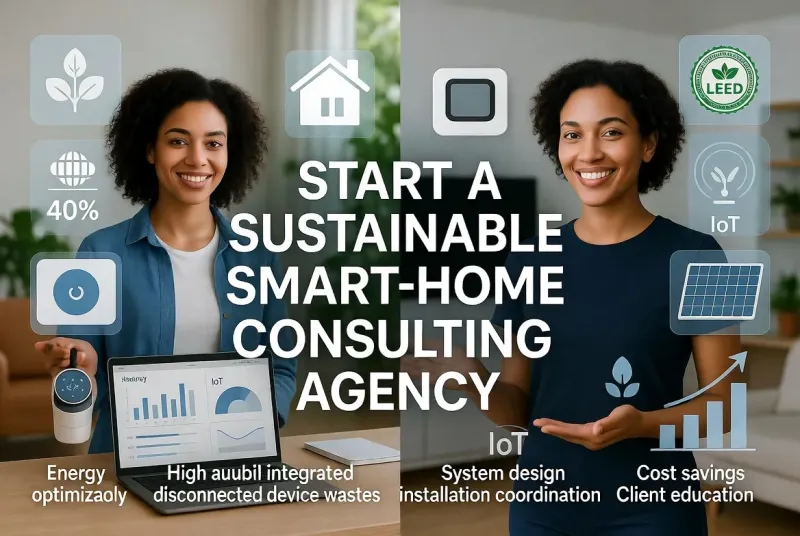
How to Start a Sustainable Smart-Home Consulting Agency in the USA: A Step-by-Step Guide for 2026
The Opportunity Why Sustainable Smart-Home Consulting Is Booming in 2026
The residential smart-home market in the United States is projected to exceed $174 billion by 2027, with sustainability emerging as a primary driver of consumer adoption. Simultaneously, federal and state incentives for energy efficiency, renewable energy, and electrification are accelerating demand for expert guidance.
Key Market Drivers
1. Rising Energy Costs and Climate Awareness- Average U.S. household electricity costs increased 25% since 2020- 73% of homeowners prioritize energy efficiency in renovation decisions (National Association of Realtors, 2025)- Climate-conscious consumers seek measurable carbon footprint reduction
2. Technology Maturation and Interoperability- Matter protocol (launched 2022) enables cross-brand smart home device compatibility- AI-powered energy management systems optimize usage automatically- Consumer-friendly interfaces reduce adoption barriers
3. Policy and Incentive Support- Inflation Reduction Act (IRA) offers tax credits up to $3,200 for home energy improvements- State-level rebates for smart thermostats, energy monitoring, and electrification- Building codes increasingly require energy-efficient and smart-ready construction
4. Professional and Builder Demand- Custom home builders seek consultants to differentiate properties with sustainable tech- Property managers need scalable solutions for multifamily energy optimization- Real estate agents value "smart + green" certifications for property valuation
5. Underserved Market Segment- Many homeowners feel overwhelmed by technology choices and integration complexity- Fragmented vendor landscape creates confusion about compatible, effective solutions- Trust gap: consumers prefer independent advisors over product-specific salespeople
This convergence creates a significant opportunity for consultants who can bridge technology expertise, sustainability knowledge, and client-centered service delivery.
Step 1 Define Your Niche and Value Proposition
Not all smart-home consulting is equal. Specialization helps you stand out, command premium pricing, and build deep expertise. Consider these niche options:
Niche Options for Sustainable Smart-Home Consulting
🏡 Residential Energy Optimization- Focus: Reduce household energy consumption through smart technology- Services: Energy audits, smart thermostat integration, load monitoring, appliance optimization- Target Clients: Homeowners seeking lower bills and carbon reduction- Differentiator: Quantifiable ROI calculations and utility rebate navigation
🌱 Net-Zero and Passive Home Integration- Focus: Smart technology for ultra-efficient, net-zero energy homes- Services: System design for solar + storage integration, passive house automation, energy modeling- Target Clients: Custom home builders, eco-luxury homeowners, green developers- Differentiator: Advanced technical expertise and certification alignment
🏢 Multifamily and Property Management Solutions- Focus: Scalable smart-home solutions for apartments, condos, and rental properties- Services: Centralized monitoring systems, tenant-facing interfaces, maintenance automation- Target Clients: Property management companies, real estate investment trusts (REITs), housing authorities- Differentiator: B2B sales expertise and scalable deployment models
♿ Accessibility and Aging-in-Place Smart Homes- Focus: Smart technology supporting independent living for seniors and people with disabilities- Services: Voice-controlled automation, fall detection integration, remote monitoring for caregivers- Target Clients: Families with aging relatives, senior living communities, healthcare organizations- Differentiator: Empathy-driven design and accessibility standards expertise
🔐 Smart Home Security + Sustainability- Focus: Integrated systems that enhance both security and energy efficiency- Services: Smart locks with energy-aware scheduling, security cameras with low-power modes, unified control platforms- Target Clients: Security-conscious homeowners, insurance companies, high-value properties- Differentiator: Dual expertise in cybersecurity and energy optimization
Crafting Your Value Proposition:Answer these questions clearly:- Who specifically do you serve? (e.g., "Eco-conscious homeowners in the Pacific Northwest renovating 1970s-1990s homes")- What specific problem do you solve? (e.g., "Reduce energy bills by 30-50% through integrated smart technology")- What makes you different? (e.g., "Independent advisor with no vendor affiliations + certified energy auditor credentials")- What tangible outcomes do clients receive? (e.g., "Custom implementation roadmap, utility rebate applications, 1-year performance guarantee")
Example Value Proposition:"EcoSmart Home Consulting helps Pacific Northwest homeowners reduce energy costs by 40% and carbon footprint by 3 tons annually through integrated, vendor-neutral smart home technology—backed by BPI certification, utility partnership access, and a 100% satisfaction guarantee."
Step 2 Acquire Essential Knowledge and Certifications
Credibility is critical in consulting. Invest in credentials that validate your expertise to clients, partners, and regulators.
Core Knowledge Areas
1. Smart Home Technology Fundamentals- Communication protocols: Wi-Fi, Zigbee, Z-Wave, Thread, Matter- Platform ecosystems: Apple HomeKit, Google Home, Amazon Alexa, Samsung SmartThings, Home Assistant- Device categories: Thermostats, lighting, security, energy monitoring, appliances, voice assistants- Integration principles: Automation logic, scene creation, interoperability troubleshooting
2. Energy Efficiency and Building Science- Home energy audit methodologies (blower door tests, thermal imaging)- HVAC system optimization and smart thermostat programming- Building envelope considerations (insulation, air sealing, windows)- Renewable energy integration (solar PV, battery storage, EV charging)
3. Sustainability Metrics and Standards- Carbon footprint calculation methodologies- Energy Star, LEED, Passive House, and Net Zero certification requirements- Life-cycle assessment of technology choices- Embodied carbon considerations in device selection
4. Business and Consulting Skills- Client discovery and needs assessment- Proposal writing and scope definition- Project management and vendor coordination- Communication and change management for technology adoption
Recommended Certifications (USA Focus)
✅ Building Performance Institute (BPI) Building Analyst Professional- Industry gold standard for residential energy auditing- Covers building science, diagnostics, and retrofit recommendations- Required for many utility rebate programs- Cost: ~$1,200 for training + exam; renewal every 3 years
✅ RESNET HERS Rater Certification- Focuses on Home Energy Rating System (HERS) indexing- Valuable for new construction and major renovation consulting- Recognized by lenders, builders, and incentive programs- Cost: ~$2,000-3,500 for training + certification
✅ Passive House Consultant (PHI or PHIUS)- Advanced certification for ultra-low energy building design- Highly valued in custom luxury and eco-building markets- Cost: ~$3,000-5,000 for training + exam
✅ Matter Certified Professional (via Connectivity Standards Alliance)- Emerging credential for interoperability expertise- Signals up-to-date knowledge of cross-platform smart home standards- Cost: Varies; often included in partner training programs
✅ Project Management Professional (PMP) or Certified Associate in Project Management (CAPM)- Demonstrates project delivery discipline- Valuable for managing complex, multi-vendor installations- Cost: PMP ~$555 exam fee + experience requirements; CAPM ~$300
✅ LEED Green Associate- Broad sustainability credential recognized across building industries- Useful for working with green builders and developers- Cost: ~$250 exam fee + study materials
✅ Manufacturer-Specific Certifications (Strategic Selection)- Examples: Nest Pro, Lutron Certified, Control4 Certified, Savant Professional- Provide product expertise and potential referral partnerships- Caution: Maintain vendor neutrality in client recommendations
Learning Resources:- Online Courses: Coursera (Smart Home Technology), edX (Sustainable Building Design), LinkedIn Learning (Energy Auditing)- Industry Associations: Custom Electronic Design andamp; Installation Association (CEDIA), Smart Home Association, U.S. Green Building Council (USGBC)- Continuing Education: Webinars, trade shows (CES, Greenbuild), manufacturer training programs
Step 3 Establish Your Business Legally and Financially
Proper business formation protects you and builds client confidence.
Legal Structure Options
1. Sole Proprietorship- Simplest to establish; minimal paperwork- No legal separation between you and the business (unlimited personal liability)- Best for: Testing the business concept with minimal risk
2. Limited Liability Company (LLC)- Recommended for most consultants- Provides liability protection while maintaining tax flexibility- Can be single-member or multi-member- Cost: $50-500 state filing fees + annual reports
3. S-Corporation (S-Corp)- Potential tax advantages once revenue exceeds ~$75,000/year- More complex administration (payroll, corporate formalities)- Best for: Established consultants with consistent revenue
Registration Steps:1. Choose and register business name (check state database for availability)2. File formation documents with your state (Articles of Organization for LLC)3. Obtain Employer Identification Number (EIN) from IRS (free)4. Register for state/local business licenses and sales tax permits if applicable5. Open a dedicated business bank account6. Set up accounting software (QuickBooks, FreshBooks, or Wave)
Essential Insurance:- Professional Liability (Errors andamp; Omissions): Protects against claims of negligent advice or service failures ($500-2,000/year)- General Liability: Covers property damage or bodily injury during site visits ($400-1,200/year)- Cyber Liability: Important if handling client data or smart home access credentials ($300-1,000/year)- Business Owner's Policy (BOP): Bundles general liability + property coverage (cost-effective option)
Financial Setup:- Business bank account: Separate personal and business finances- Accounting system: Track income, expenses, mileage, and project profitability- Payment processing: Stripe, Square, or PayPal for client invoicing- Pricing strategy: Develop rate cards for different service tiers (see Step 5)- Emergency fund: Maintain 3-6 months of operating expenses
Step 4 Develop Your Service Portfolio and Pricing Model
Clarity about what you offer—and what you charge—is essential for client acquisition and business sustainability.
Core Service Offerings
Tier 1: Assessment and Strategy ($250-750)- Initial consultation: 60-90 minute discovery session (virtual or in-person)- Home technology audit: Inventory of existing devices, infrastructure assessment- Energy baseline analysis: Review utility bills, identify optimization opportunities- Custom roadmap: Prioritized recommendations with budget ranges and ROI estimates- Deliverable: PDF report with implementation timeline and vendor-agnostic guidance
Tier 2: Design and Procurement Support ($500-2,500)- System architecture design: Device selection, network planning, automation logic- Vendor coordination: Research and recommend qualified installers or products- Incentive navigation: Identify and apply for utility rebates, tax credits, grants- Procurement assistance: Help clients source equipment at competitive pricing- Deliverable: Detailed implementation plan, vendor contacts, rebate applications
Tier 3: Implementation Oversight ($1,000-5,000+)- Project management: Coordinate installers, troubleshoot integration issues- Quality assurance: Test systems, verify performance against goals- Client training: Teach homeowners to use and maintain their smart home- Performance monitoring: 30-90 day follow-up to optimize settings- Deliverable: Fully functional system, user documentation, performance report
Tier 4: Ongoing Support and Optimization (Retainer: $75-300/month)- Remote monitoring: Track energy usage, system health, and automation performance- Proactive optimization: Adjust settings seasonally or as usage patterns change- Troubleshooting support: Phone/email assistance for technical issues- Technology updates: Advise on firmware updates, new features, or upgrades- Deliverable: Peace of mind and continuous value from smart home investment
Pricing Strategies
Option A: Hourly Consulting- Rate range: $75-200/hour depending on experience, location, and specialization- Best for: Initial consultations, troubleshooting, small-scope projects- Pros: Simple to implement; flexible for clients- Cons: Revenue capped by your time; clients may resist open-ended engagements
Option B: Fixed-Project Pricing- Package assessments, design, or implementation as fixed-fee engagements- Example: "Smart Home Energy Audit + Roadmap" = $495- Best for: Well-defined scopes with predictable effort- Pros: Predictable revenue; clients appreciate cost certainty- Cons: Requires accurate scoping; risk of scope creep
Option C: Value-Based Pricing- Price based on client outcomes (e.g., "15% of first-year energy savings")- Best for: High-confidence engagements with measurable ROI- Pros: Aligns incentives; potential for high margins- Cons: Complex to structure; requires trust and performance guarantees
Option D: Retainer Model- Monthly fee for ongoing advisory, monitoring, or support services- Example: $150/month for remote optimization + quarterly check-ins- Best for: Building recurring revenue and long-term client relationships- Pros: Predictable cash flow; deeper client partnerships- Cons: Requires consistent value delivery to justify ongoing cost
Recommended Approach for New Consultants:Start with fixed-project pricing for core services (assessment, design) to build portfolio and testimonials. Add hourly consulting for ad-hoc requests. Introduce retainers once you have 5-10 satisfied clients ready for ongoing support.
Step 5 Build Your Technology Stack and Partnerships
Your effectiveness depends on the tools you use and the partners you collaborate with.
Essential Technology Tools
1. Assessment and Analysis Software- Energy auditing: Home Energy Saver, REM/Rate, or Ekotrope for modeling- Smart home design: SmartThings IDE, Home Assistant blueprints, or custom documentation templates- Carbon calculation: EcoChain, WattTime, or custom spreadsheets aligned with EPA guidelines
2. Project Management and Client Communication- CRM: HubSpot (free tier), Zoho CRM, or Copper for lead tracking- Project management: Asana, Trello, or ClickUp for task coordination- Communication: Calendly for scheduling, Zoom for virtual consults, Slack for team collaboration (if scaling)
3. Documentation and Reporting- Proposal tools: PandaDoc, Proposify, or Google Docs templates- Reporting: Canva for client-facing reports; Google Data Studio for energy dashboards- Contract management: HelloSign or DocuSign for e-signatures
4. Business Operations- Accounting: QuickBooks Online, FreshBooks, or Wave- Invoicing: Integrated with accounting software or standalone (Square Invoices)- Time tracking: Toggl Track or Clockify for hourly work
Strategic Partnerships
1. Installation and Integration Partners- Vet and maintain a network of qualified smart home installers, electricians, and low-voltage technicians- Establish referral agreements (e.g., 10-15% referral fee or reciprocal referrals)- Ensure partners share your commitment to quality and sustainability
2. Product and Platform Partners- Develop relationships with manufacturers whose products align with your values (energy efficiency, interoperability, repairability)- Pursue certified partner status where it adds credibility without compromising independence- Negotiate affiliate commissions for product recommendations (disclose transparently to clients)
3. Utility and Incentive Program Partners- Connect with local utility companies' energy efficiency programs- Become a recognized contractor or advisor for rebate processing- Stay updated on changing incentive landscapes to maximize client savings
4. Real Estate and Builder Partners- Partner with real estate agents specializing in green or luxury properties- Offer pre-listing smart home audits to enhance property value- Collaborate with custom home builders on integrated design services
5. Sustainability and Certification Organizations- Align with USGBC, Passive House Institute, or local green building councils- Participate in certification projects to build credibility and referral networks- Contribute expertise to industry publications or speaking engagements
Step 6 Acquire Your First Clients
Marketing your consulting services requires a strategic blend of credibility-building, targeted outreach, and value demonstration.
Foundation Build Your Professional Presence
1. Professional Website- Clear value proposition and niche focus above the fold- Services page with pricing ranges or "starting at" guidance- Case studies or hypothetical examples demonstrating your process and outcomes- Credentials, certifications, and partnership logos for trust signals- Contact form with qualifying questions (location, project scope, timeline)- SEO optimization for local and niche keywords (e.g., "sustainable smart home consultant Seattle")
2. LinkedIn Optimization- Headline: "Sustainable Smart Home Consultant | Helping [niche] reduce energy costs through integrated technology"- About section: Story-driven narrative connecting your expertise to client outcomes- Experience: Detail relevant background, certifications, and project examples- Content: Share insights on smart home trends, energy efficiency tips, and case studies- Networking: Connect with real estate agents, builders, sustainability professionals in your target market
3. Local Business Directories- Google Business Profile: Essential for local SEO and client reviews- Nextdoor, Yelp, Angi: List services and encourage satisfied clients to review- Chamber of Commerce: Join local business groups for networking and credibility
Content Marketing Strategy
1. Educational Blog Content- Topics: "Smart Thermostat Savings Calculator," "Matter Protocol Explained for Homeowners," "How to Qualify for IRA Home Energy Tax Credits"- Goal: Attract organic search traffic and position yourself as a trusted resource- Frequency: 1-2 posts/month initially; repurpose into social media snippets
2. Video Content- Short-form: TikTok/Instagram Reels showing quick smart home tips or before/after energy savings- Long-form: YouTube tutorials on smart home setup, energy audit walkthroughs, client testimonials (with permission)- Live sessions: Qandamp;A webinars on topics like "Preparing Your Home for Smart Technology"
3. Lead Magnets- Free resources in exchange for email signups:andnbsp; • "Smart Home Energy Savings Checklist"andnbsp; • "IRA Home Energy Tax Credit Eligibility Guide"andnbsp; • "10 Questions to Ask Before Hiring a Smart Home Consultant"- Nurture email subscribers with valuable content and occasional service offers
Targeted Outreach Tactics
1. Real Estate Agent Partnerships- Offer free "Smart Home Value Assessment" for their listings- Provide co-branded marketing materials highlighting smart + green features- Share referral fees or reciprocal lead generation
2. Builder and Developer Collaborations- Propose "Smart + Sustainable" upgrade packages for new construction- Offer design consultations during client selection meetings- Provide specification documents for smart home infrastructure in plans
3. Utility Program Engagement- Become a recommended advisor for utility energy efficiency programs- Host workshops or webinars sponsored by utilities- Leverage utility marketing channels to reach motivated homeowners
4. Community and Industry Events- Speak at local sustainability fairs, home shows, or green building conferences- Sponsor or participate in neighborhood association meetings- Join professional associations (CEDIA, USGBC) for networking and visibility
5. Referral Program- Incentivize past clients to refer friends (e.g., $100 credit toward future services)- Partner with complementary service providers (energy auditors, solar installers) for cross-referrals- Request testimonials and case study participation from satisfied clients
Step 7 Deliver Exceptional Client Experiences
Your reputation—and growth—depends on client satisfaction and word-of-mouth referrals.
Best Practices for Client Engagement
1. Thorough Discovery Process- Use structured questionnaires to understand client goals, budget, and constraints- Conduct in-person or virtual home assessments when feasible- Clarify expectations about outcomes, timeline, and your role vs. installer responsibilities
2. Transparent Communication- Provide written scope of work, timeline, and pricing before beginning work- Set clear boundaries about communication channels and response times- Proactively update clients on progress, challenges, or changes
3. Vendor-Neutral Recommendations- Prioritize client outcomes over product affiliations- Disclose any affiliate relationships or referral fees transparently- Provide multiple options at different price points when appropriate
4. Documentation and Knowledge Transfer- Deliver clear, accessible documentation of system design and settings- Provide training sessions (in-person or recorded) for homeowners- Share maintenance tips and troubleshooting guidance
5. Performance Follow-Up- Schedule check-ins at 30 and 90 days post-implementation- Review energy usage data and adjust settings to optimize performance- Solicit feedback and testimonials for continuous improvement
Managing Scope and Expectations:- Use detailed statements of work to prevent scope creep- Include change order processes for additional requests- Educate clients about the iterative nature of smart home optimization
Step 8 Scale Your Agency Strategically
Once you've validated your model with initial clients, consider growth pathways
Growth Strategies
1. Expand Service Offerings- Add complementary services: EV charging consultation, water efficiency monitoring, indoor air quality integration- Develop specialized packages: "New Home Smart Setup," "Rental Property Tech Upgrade," "Senior Living Smart Solutions"
2. Build a Team- Hire associate consultants for assessment and design work- Partner with freelance specialists (cybersecurity, accessibility, advanced automation)- Outsource administrative tasks (scheduling, invoicing) to focus on client work
3. Develop Products and IP- Create standardized assessment tools, templates, or software you can license- Publish guides, courses, or certification programs for other consultants- Build proprietary analytics dashboards for client reporting
4. Geographic Expansion- Serve clients remotely for design and consulting; partner with local installers for implementation- Target regions with strong sustainability incentives or high energy costs- Consider franchising or licensing your methodology to consultants in other markets
5. B2B and Enterprise Focus- Shift focus to property management companies, home builders, or institutional clients- Develop scalable solutions and pricing models for volume engagements- Build case studies demonstrating ROI at portfolio level
Key Metrics to Track:- Client acquisition cost (CAC) and lifetime value (LTV)- Project profitability by service tier- Client satisfaction scores and referral rates- Revenue diversification (one-time projects vs. retainers)- Time allocation (billable vs. business development vs. admin)
Sustainability and Ethics Maintaining Your Mission
As you grow, stay anchored to your core values
✅ Maintain Vendor Neutrality- Avoid exclusive partnerships that limit client options- Disclose any financial relationships with product vendors- Prioritize client outcomes over commission potential
✅ Advocate for Repairability and Longevity- Recommend devices with modular design, software update commitments, and repair support- Discourage planned obsolescence and e-waste-generating practices- Support right-to-repair initiatives in your industry engagements
✅ Practice What You Preach- Operate your own business sustainably: remote work, digital documentation, carbon-offset travel- Measure and report your own business's environmental impact- Continuously improve your practices based on emerging best practices
✅ Promote Equity and Access- Offer sliding-scale pricing or pro bono services for underserved communities- Advocate for inclusive smart home design (accessibility, affordability, multilingual support)- Partner with organizations expanding sustainable technology access
Conclusion Building a Purpose-Driven Business That Matters
Starting a sustainable smart-home consulting agency in the USA in 2026 is more than a business opportunity—it's a chance to accelerate the transition to efficient, resilient, and human-centered homes. By combining technical expertise, sustainability knowledge, and client-centered service, you can help families reduce their environmental impact while saving money, improving comfort, and future-proofing their largest asset.
Success requires more than knowledge: it demands intentional positioning, credible credentials, strategic partnerships, and relentless focus on client outcomes. Start small, validate your approach with early clients, and scale thoughtfully while staying true to your mission.
Your journey begins with one decision: to use your skills to make homes smarter, greener, and more sustainable—one client at a time.
Key Takeaways:✅ Specialize to stand out: Define a clear niche and value proposition✅ Invest in credibility: Pursue certifications that validate your expertise✅ Price for value: Structure offerings that reflect outcomes, not just hours✅ Build partnerships: Collaborate with installers, utilities, and real estate professionals✅ Deliver exceptional experiences: Documentation, communication, and follow-up drive referrals✅ Scale intentionally: Grow services, team, or geography based on validated demand✅ Stay mission-aligned: Prioritize sustainability, ethics, and equity as you scale
The homes of tomorrow are being designed today. With the right preparation, passion, and strategy, you can be the guide that helps clients build them—while building a thriving, purpose-driven business.
For additional resources on smart home technology, sustainability certifications, and small business development in the USA, explore trusted industry associations, government programs, and professional networks committed to innovation and environmental stewardship. Your consulting journey starts with one intentional step.
For curated tools, certification pathways, and business resources tailored to sustainable technology consulting, discover specialized platforms supporting entrepreneurs who are building a smarter, greener future. Launch your agency with confidence, competence, and commitment to impact.