

How to Use 6G Technology to Stay Connected as a Digital Nomad in Remote Asia
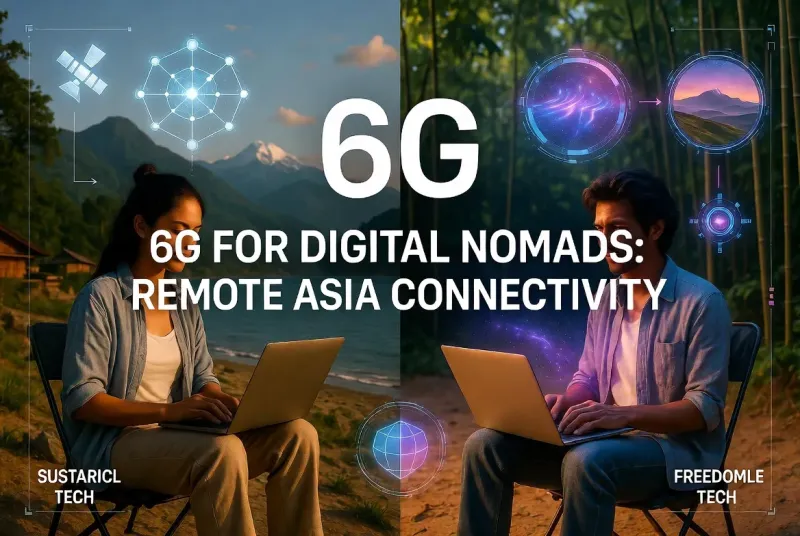
Understanding the Connectivity Landscape 6G, Today's Solutions, and Remote Asia
The term "6G" generates excitement, but it's crucial to separate near-future possibilities from current realities. As of 2026, sixth-generation wireless technology remains in research, standardization, and early testing phases. Commercial deployment is projected for 2030-2035 in leading markets, with broader global availability likely later.
However, the technologies being developed for 6G—integrated satellite-terrestrial networks, AI-optimized connectivity, terahertz frequencies, and ultra-low-latency communications—are already influencing today's solutions. For digital nomads in remote Asia, understanding this trajectory helps you make smart investments in connectivity that will remain relevant as technology evolves.
What 6G Promises for Digital Nomads (Future Outlook)
While you can't buy a "6G plan" today, these emerging capabilities define what's coming
Capability 1: Integrated Space-Air-Ground Networks- Seamless handoff between terrestrial cellular, low Earth orbit (LEO) satellites, high-altitude platforms (drones, balloons), and ground stations- No more "dead zones": connectivity follows you across mountains, oceans, and remote villages- Relevance for Asia: Critical for regions with challenging terrain like the Himalayas, Indonesian archipelago, or rural Central Asia
Capability 2: AI-Native Network Optimization- Networks that predict your location, usage patterns, and connectivity needs- Automatic switching between available networks for optimal speed, latency, and cost- Relevance for Asia: Essential for nomads moving frequently between countries with different carriers and infrastructure quality
Capability 3: Ultra-Low Latency (andlt;1ms)- Near-instantaneous data transmission enabling real-time holographic collaboration, remote robotics, and immersive VR workspaces- Relevance for Asia: Enables high-quality video calls, cloud-based development, and real-time collaboration regardless of physical location
Capability 4: Terahertz Spectrum andamp; Massive Bandwidth- Frequencies above 100 GHz enabling multi-gigabit speeds and massive device connectivity- Relevance for Asia: Supports data-intensive work like 4K video editing, large file transfers, and AI model training from remote locations
Capability 5: Energy-Efficient, Sustainable Connectivity- Lower power consumption per bit transmitted, critical for nomads relying on solar or battery power- Relevance for Asia: Aligns with eco-conscious travel and off-grid living in remote destinations
Reality Check What's Available Now in Remote Asia
While waiting for 6G, digital nomads can leverage today's most advanced connectivity solutions. Here's what actually works in remote Asia in 2026:
Solution 1 Low Earth Orbit (LEO) Satellite Internet
Providers Operating in Asia:- Starlink: Available in Japan, Philippines, Malaysia, Thailand (partial), with approvals pending in India, Vietnam, Indonesia- OneWeb: Coverage across much of Asia via partnerships with local telecoms- Amazon Kuiper: Early testing phases; expected broader Asia coverage 2027-2028- Regional players: China's Guowang, India's OneWeb partnership, Southeast Asian consortiums
Performance in Remote Asia:- Latency: 20-50ms (vs. 600ms+ for traditional geostationary satellites)- Speeds: 50-200 Mbps download typical; varies by location and network load- Reliability: Generally excellent; weather can cause brief interruptions- Portability: Starlink's "Flat High Performance" and "Mobile Priority" plans support nomadic use
Practical Considerations:- Regulatory approval varies by country; research before traveling- Equipment cost: $300-2,500 depending on terminal type- Monthly service: $50-250+ depending on data needs and mobility- Power requirements: 50-100W; plan for solar/battery solutions in off-grid locations
Best For: Extended stays in truly remote areas (mountain villages, islands, rural regions) where cellular coverage is unreliable or nonexistent.
Solution 2 Multi-Carrier eSIM Strategies
Why eSIMs Excel for Asian Nomads:- Instant activation across 200+ countries without physical SIM swaps- Ability to stack multiple regional plans for redundancy- Dynamic switching between carriers based on signal strength and cost- No contract commitments; pay-as-you-go flexibility
Top eSIM Providers for Asia:- Airalo: Extensive Asia coverage; regional "AsiaDiscover" and country-specific plans- Nomad: Competitive pricing; strong Southeast Asia coverage- Holafly: Unlimited data options; good for heavy users- Ubigi: Premium reliability; excellent Japan and South Korea coverage- Local carrier eSIMs: Many Asian telcos now offer direct eSIM activation
Strategic Approach:1. Primary Plan: Choose a regional eSIM covering your main destinations (e.g., "Asia Pacific" plan)2. Backup Plan: Add a country-specific eSIM for your longest stay location3. Emergency Plan: Keep a global fallback eSIM with minimal data for critical communications4. Monitor Usage: Use apps to track data consumption and switch plans proactively
Performance Expectations:- 4G/LTE: 10-50 Mbps typical in urban/suburban Asia; 1-10 Mbps in rural areas- 5G: 100-500+ Mbps where available (major cities in Japan, South Korea, Singapore, parts of China, Thailand, Malaysia)- Coverage gaps: Expect limited or no service in remote mountains, islands, and rural villages
Best For: Nomads moving between established destinations with decent cellular infrastructure; urban and semi-rural travel.
Solution 3 Hybrid Connectivity Systems
The Most Reliable Approach Combine multiple technologies for redundancy.
Recommended Setup for Remote Asia
Primary Connection:- Local 4G/5G via eSIM or physical SIM when available- Fast, low-cost, low-latency for daily work
Backup Connection:- LEO satellite terminal (Starlink Mini or similar) for true remote locations- Activated only when cellular fails; conserves battery and data
Tertiary Backup:- Portable Wi-Fi hotspot with multi-SIM capability- Pre-loaded with regional SIMs for quick failover
Power Management:- Solar charger (100W+ foldable panel) for extended off-grid stays- High-capacity power bank (20,000mAh+) for daily mobility- Efficient devices: laptops with all-day battery, low-power satellite terminals
Connectivity Management Software:- Speedify or similar bonding software: aggregates multiple connections for reliability- Network monitoring apps: alert you to signal degradation before it impacts work- Automated failover: scripts or tools that switch connections seamlessly
Best For: Professional nomads whose income depends on reliable connectivity; those working in unpredictable or extremely remote locations.
Solution 4 Edge Computing andamp; Local Caching
Reduce Dependency on Constant Connectivity
Strategies:- Download critical files, documentation, and media before traveling to low-connectivity areas- Use offline-capable tools: Notion offline mode, Google Docs offline, local code repositories- Leverage edge computing: Process data locally when possible; sync when connectivity returns- Async communication: Embrace tools that don't require real-time responses (Loom, asynchronous project management)
Tools to Implement:- Syncthing or Resilio Sync: Peer-to-peer file synchronization that works intermittently- Local development environments: Docker, VS Code with remote-SSH for when you do have connection- Offline-first apps: Choose software designed to function without constant internet
Best For: Developers, writers, designers, and other knowledge workers who can structure work around intermittent connectivity.
Regional Connectivity Guide Remote Asia Destinations
Southeast Asia
Thailand:- 5G Coverage: Excellent in Bangkok, Chiang Mai, Phuket; limited in rural north and islands- Satellite Options: Starlink approved for maritime/aviation; terrestrial use in regulatory gray area- eSIM Strategy: AIS, TrueMove, or dtac eSIMs for primary; regional Airalo plan as backup- Remote Work Hubs: Chiang Mai, Pai, Koh Lanta have strong digital nomad infrastructure
Vietnam:- 5G Coverage: Rolling out in major cities; 4G reliable in most populated areas- Satellite Options: Starlink not yet approved; rely on cellular + portable Wi-Fi- eSIM Strategy: Viettel, Vinaphone, or Mobifone eSIMs; test coverage before remote stays- Remote Work Hubs: Da Nang, Hoi An, Dalat offer good connectivity with rural access
Indonesia:- 5G Coverage: Limited to Jakarta, Bali, Surabaya; archipelago creates major coverage gaps- Satellite Options: Starlink in approval process; OneWeb partnerships expanding- eSIM Strategy: Telkomsel (best rural coverage) + regional backup; expect island-hopping challenges- Remote Work Hubs: Bali (Canggu, Ubud) excellent; remote islands require satellite planning
Philippines:- 5G Coverage: Growing in Metro Manila, Cebu, Davao; limited elsewhere- Satellite Options: Starlink officially launched; ideal for island and rural connectivity- eSIM Strategy: Globe or Smart eSIMs for cities; Starlink for remote islands- Remote Work Hubs: Siargao, Palawan, Bicol offer adventure with improving connectivity
South Asia
Nepal:- 5G Coverage: Minimal; 4G in Kathmandu and trekking routes, but unreliable in mountains- Satellite Options: Starlink not approved; traditional satellite phones for emergency only- eSIM Strategy: Ncell or Nepal Telecom SIMs; carry multiple for redundancy- Remote Work Hubs: Kathmandu, Pokhara feasible; high-altitude trekking requires offline planning
India:- 5G Coverage: Rapidly expanding in cities; 4G widespread but congested in rural areas- Satellite Options: Starlink awaiting approval; OneWeb partnerships emerging- eSIM Strategy: Jio, Airtel, or Vi eSIMs; regional variation in quality requires testing- Remote Work Hubs: Goa, Rishikesh, Himachal Pradesh popular; research connectivity before booking
Sri Lanka:- 5G Coverage: Early stages; 4G reliable in coastal and urban areas- Satellite Options: Limited satellite approval; cellular + Wi-Fi primary strategy- eSIM Strategy: Dialog or Mobitel eSIMs; good coverage along tourist routes- Remote Work Hubs: Ella, Mirissa, Galle offer balance of beauty and connectivity
East Asia
Japan:- 5G Coverage: Excellent nationwide; even rural areas often have strong signal- Satellite Options: Starlink available; generally unnecessary except for extreme remote locations- eSIM Strategy: SoftBank, NTT Docomo, or Rakuten eSIMs; premium reliability- Remote Work Hubs: Entire country highly connected; rural ryokans often have excellent internet
South Korea:- 5G Coverage: World-leading; ubiquitous even in mountainous regions- Satellite Options: Rarely needed; cellular infrastructure exceptional- eSIM Strategy: SK Telecom, KT, or LG U+ eSIMs; seamless nationwide coverage- Remote Work Hubs: Any location feasible; even remote temples often have connectivity
Taiwan:- 5G Coverage: Strong in cities and many rural areas; mountain regions variable- Satellite Options: Starlink available; useful for high-altitude or offshore locations- eSIM Strategy: Chunghwa Telecom, Taiwan Mobile, or Far EasTone eSIMs- Remote Work Hubs: Taroko Gorge, Alishan, offshore islands require connectivity research
Central Asia
Kazakhstan, Kyrgyzstan, Uzbekistan:- 5G Coverage: Limited to major cities; 4G expanding but rural coverage spotty- Satellite Options: Varies by country; research regulations before travel- eSIM Strategy: Local carrier SIMs often more reliable than eSIMs in this region- Remote Work Hubs: Almaty, Bishkek, Tashkent feasible; mountain trekking requires satellite planning
Practical Implementation Your 6G-Ready Connectivity Setup
Hardware Checklist
Essential Devices:1. Unlocked Smartphone with eSIM Supportandnbsp; andnbsp;- iPhone 14/15/16 series or recent Android flagshipsandnbsp; andnbsp;- Enables instant carrier switching without physical SIMs
2. Portable Satellite Terminalandnbsp; andnbsp;- Starlink Mini (if approved in destination) or equivalent LEO terminalandnbsp; andnbsp;- Backup for truly remote locations; test before critical trips
3. Multi-SIM Portable Hotspotandnbsp; andnbsp;- Device supporting 4G/5G with multiple SIM slotsandnbsp; andnbsp;- Pre-load with regional SIMs for quick failover
4. High-Capacity Power Solutionsandnbsp; andnbsp;- 100W+ foldable solar panel for extended off-grid staysandnbsp; andnbsp;- 20,000mAh+ power bank for daily mobilityandnbsp; andnbsp;- Universal travel adapter with USB-C PD support
5. Connectivity Management Toolsandnbsp; andnbsp;- Speedify or similar bonding software for connection aggregationandnbsp; andnbsp;- Network monitoring app for proactive signal managementandnbsp; andnbsp;- Offline-capable productivity suite
Software andamp; Account Setup
Pre-Trip Preparation:1. Research Regulatory Landscapeandnbsp; andnbsp;- Check satellite internet legality in each destination countryandnbsp; andnbsp;- Verify eSIM compatibility with local carriersandnbsp; andnbsp;- Understand data privacy laws affecting your work
2. Establish Redundant Accountsandnbsp; andnbsp;- Multiple eSIM providers with funded accountsandnbsp; andnbsp;- Satellite service activated and testedandnbsp; andnbsp;- Cloud storage with offline sync capabilities
3. Configure Offline Workflowsandnbsp; andnbsp;- Download critical files before traveling to low-connectivity areasandnbsp; andnbsp;- Set up local development environmentsandnbsp; andnbsp;- Test async communication tools with your team
4. Create Connectivity Playbooksandnbsp; andnbsp;- Document which connections work best in which locationsandnbsp; andnbsp;- Establish failover procedures for critical work momentsandnbsp; andnbsp;- Share backup communication plans with clients/employers
Daily Connectivity Routine
Morning Check (5 minutes):- Test primary connection speed and latency- Verify backup systems are charged and ready- Review weather forecast for potential connectivity impacts
Work Session Protocol:- Use bonding software to aggregate available connections- Prioritize critical tasks during peak connectivity windows- Schedule large uploads/downloads for optimal network times
Evening Maintenance (10 minutes):- Sync offline work to cloud when connectivity is strong- Charge all devices and power banks- Review next day's location and connectivity expectations
Troubleshooting Framework
When Connectivity Fails
Step 1: Diagnose- Is it device, network, or location issue?- Test with multiple devices if possible- Check service status pages for outages
Step 2: Failover- Switch to backup connection immediately- Notify stakeholders of temporary limitations- Shift to offline-capable tasks if needed
Step 3: Escalate- Contact carrier support if issue persists- Use satellite terminal for critical communications only- Relocate to area with better signal if feasible
Step 4: Document- Record what worked and what didn't- Update your connectivity playbook- Share insights with fellow nomads
Sustainable andamp; Ethical Considerations
As a digital nomad leveraging advanced technology in remote Asia, your choices impact local communities and environments:
Minimize Electronic Waste:- Choose durable, repairable devices over disposable tech- Properly recycle old equipment; don't abandon it in remote locations- Support manufacturers with take-back programs
Respect Local Infrastructure:- Don't overwhelm small village networks with heavy bandwidth usage- Contribute to local connectivity improvements when possible- Learn basic phrases in local languages to navigate connectivity challenges respectfully
Support Conservation:- Choose eco-friendly accommodations and tour operators- Offset carbon emissions from travel and tech shipping- Advocate for sustainable technology deployment in developing regions
Future-Proofing Your Investment
While 6G isn't here yet, these strategies ensure your connectivity setup remains valuable
Invest in Modular Hardware:- Devices with upgradeable components or software-defined capabilities- Terminals that can receive firmware updates for new network standards- Accessories compatible with multiple generations of technology
Prioritize Software Over Hardware:- Connectivity management tools that adapt to new networks- Offline-first applications that reduce dependency on constant connection- Cloud services with robust offline synchronization
Build Knowledge, Not Just Gear:- Learn network fundamentals to troubleshoot across technologies- Stay informed about emerging standards and regional deployments- Connect with nomad communities to share real-world insights
Timeline Expectations When Will 6G Reach Remote Asia?
Realistic Deployment Projections
2026-2028: Research andamp; Early Testing- 6G standards finalization (ITU, 3GPP)- Prototype networks in leading markets (China, South Korea, Japan)- Limited commercial trials in urban centers
2029-2032: Initial Commercial Deployment- First 6G networks in major Asian cities- Early satellite-terrestrial integration demonstrations- Premium devices with 6G capabilities (high cost, limited availability)
2033-2035: Broader Regional Availability- 6G coverage expanding to secondary cities and tourist regions- Improved device affordability and battery efficiency- More seamless roaming across Asian countries
2036+: Widespread Remote Coverage- Integrated space-air-ground networks reaching rural and remote areas- Affordable devices and plans for general consumers- True "connectivity anywhere" becoming reality
What This Means for Your Planning
Short Term (Now-2028):- Focus on optimizing current 4G/5G + satellite solutions- Invest in flexible, multi-technology setups- Build skills for working with intermittent connectivity
Medium Term (2029-2032):- Begin transitioning to early 6G-capable devices as they become available- Leverage improved satellite-terrestrial integration- Take advantage of expanding coverage in popular nomad destinations
Long Term (2033+):- Embrace truly seamless connectivity across remote Asia- Focus on application innovation enabled by ultra-low latency- Contribute to sustainable deployment of advanced networks
Conclusion Connect Today, Prepare for Tomorrow
While the promise of 6G excites the imagination, digital nomads in remote Asia don't need to wait for the future to stay connected. By strategically combining today's most advanced solutions—LEO satellite internet, multi-carrier eSIMs, hybrid connectivity systems, and smart offline workflows—you can work productively from virtually anywhere on the continent.
The key is intentional planning: research your destinations, invest in redundant systems, master offline-capable tools, and build the knowledge to adapt as technology evolves. As 6G and its enabling technologies gradually deploy across Asia, your forward-thinking approach will ensure you're ready to leverage each advancement.
Remember: connectivity is a means, not an end. The goal isn't just to stay online—it's to embrace the freedom of remote Asia while maintaining the professional reliability that sustains your nomadic lifestyle. With the right preparation, you can have both.
For curated connectivity solutions, regional eSIM recommendations, and expert guidance on remote work technology for Asia, explore specialized resources that prioritize real-world testing, sustainability, and digital nomad needs. Your journey to seamless connectivity in remote Asia starts with one informed decision at a time.
For thoughtfully vetted satellite terminals, multi-carrier eSIM plans, and connectivity accessories designed for the unique challenges of remote Asian travel, discover trusted options through specialized tech retailers committed to digital nomad success. Stay connected, stay productive, and embrace the adventure.