
How to Write Product Descriptions That Sell — Even If You're Not a Writer
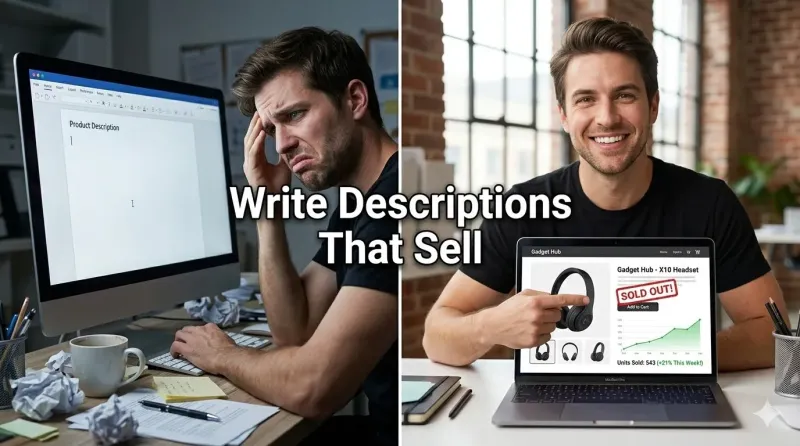
Your product might be exceptional, but if your product description falls flat, potential customers will scroll right past it. In the world of e-commerce, words are your salespeople. They answer questions, overcome objections, and persuade visitors to click "Add to Cart." Yet, for many business owners—especially those who don't consider themselves writers—crafting compelling product copy feels daunting. The good news? You don't need to be a professional copywriter to write product descriptions that sell. You just need a clear strategy, a understanding of your customer, and a few proven formulas.
Great product descriptions aren't about flowery language or complex vocabulary. They're about clarity, benefits, and connection. They translate what your product is into what it does for the customer. Whether you're launching a Shopify store, selling on Amazon, or updating an existing catalog, mastering this skill can significantly boost your conversion rates and average order value.
This comprehensive guide breaks down the art of writing product descriptions into simple, actionable steps. You'll learn how to identify your target audience, differentiate features from benefits, optimize for search engines without sounding robotic, and use templates to streamline your process. Even if writing isn't your strength, you'll walk away with the tools to create copy that converts browsers into buyers.
Why Product Descriptions Matter More Than You Think
In a physical store, customers can touch, feel, and try products. Online, they rely entirely on your images and words. Your product description bridges the gap between digital browsing and physical ownership.
The Impact on Conversion Rates
Statistics show:
- Poor product information is a top reason for cart abandonment
- Unique, detailed descriptions can increase conversion rates by up to 30%
- Customers are willing to pay more for products with clear, comprehensive information
Why it works:
- Reduces uncertainty: Answers questions before customers need to ask
- Builds trust: Shows you know your product and care about customer experience
- Creates desire: Helps customers visualize using and benefiting from the product
- Improves SEO: Unique content helps your products rank in search engines
Common Mistakes That Kill Sales
Avoid these pitfalls that turn shoppers away:
- Manufacturer copy-paste: Using generic supplier descriptions makes you look like every other seller
- Too technical: Focusing on specs without explaining benefits confuses customers
- Too vague: Phrases like "high quality" or "great value" mean nothing without proof
- Ignoring SEO: Missing opportunities to rank for relevant search terms
- Wall of text: Large blocks of text are hard to scan on mobile devices
Step 1: Know Who You're Writing For
Before typing a single word, understand who will read it. Writing for everyone means connecting with no one.
Create a Simple Buyer Persona
You don't need a complex marketing document. Just answer these three questions:
- Who are they? (Age, lifestyle, occupation, interests)
- What problem do they have? (What pain point does your product solve?)
- What do they value? (Price, quality, convenience, status, sustainability?)
Example:
- Product: Ergonomic office chair
- Who: Remote workers, ages 25-45, spend 6+ hours at desk
- Problem: Back pain, fatigue, poor posture
- Value: Comfort, health, productivity, durability
Speak Their Language
Match your tone to your audience:
- Professional/B2B: Clear, authoritative, data-driven
- Lifestyle/Consumer: Friendly, conversational, aspirational
- Luxury: Elegant, exclusive, refined
- Youth/Trend: Casual, energetic, authentic
Tip: Read reviews of similar products to see what language customers use. Incorporate their words into your descriptions.
Step 2: Features vs. Benefits (The Golden Rule)
This is the most critical concept in product copywriting. Features tell customers what the product is. Benefits tell them what it does for them.
Understanding the Difference
| Feature (What it is) | Benefit (What it does for them) |
|---|---|
| 2000mAh battery | Lasts all day without needing a charge |
| 100% organic cotton | Soft on sensitive skin and eco-friendly |
| Noise-canceling technology | Focus without distractions in noisy environments |
| Stainless steel construction | Durable and won't rust over time |
| 5-pound weight | Lightweight and easy to carry anywhere |
The "So What?" Test
For every feature you list, ask "So what?" until you reach the emotional or practical benefit.
Example:
- Feature: This jacket has a waterproof membrane.
- So what? You won't get wet in the rain.
- So what? You stay comfortable and dry during outdoor activities.
- So what? You can enjoy your hike without worrying about weather changes.
- Benefit: Stay comfortable and focused on your adventure, no matter the weather.
How to Structure It
Lead with benefits, support with features.
Weak: "This blender has a 1000-watt motor and stainless steel blades."
Strong: "Crush ice and blend frozen fruit in seconds (Benefit) with our powerful 1000-watt motor and durable stainless steel blades (Feature)."
Step 3: Crafting the Perfect Structure
A clear structure makes your description easy to scan and digest. Online shoppers skim; they don't read every word.
The Winning Formula
- Catchy Headline: Grab attention and highlight the main benefit
- Opening Hook: 2-3 sentences that connect emotionally or state the main value proposition
- Key Benefits (Bulleted): 3-5 bullet points highlighting top benefits
- Product Details/Specs: Technical information for those who want it
- Social Proof: Reviews, ratings, or trust badges
- Call to Action (CTA): Clear instruction on what to do next
Writing Each Section
1. The Headline:
- Keep it under 10 words
- Include the main benefit or unique selling proposition
- Example: "The Last Coffee Mug You'll Ever Need"
2. The Opening Hook:
- Address the customer's pain point or desire
- Set the scene for how they'll use the product
- Example: "Tired of lukewarm coffee by 10 AM? Meet the mug that keeps your drink hot for 6 hours."
3. Bullet Points:
- Focus on scannability
- Start each bullet with a benefit
- Keep them concise (1-2 lines max)
4. Product Details:
- Include dimensions, weight, materials, care instructions
- Use a table or clear list format
- Be accurate to reduce returns
Step 4: SEO Optimization Without Sacrificing Readability
You want humans to buy, but you also want search engines to find your product. Balance is key.
Keyword Research Basics
Find relevant terms:
- What would customers type into Google to find this product?
- Use tools like Google Keyword Planner, Ubersuggest, or answer questions on forums
- Look for long-tail keywords (e.g., "wireless headphones for running" vs. "headphones")
Where to place keywords:
- Product title (most important)
- First paragraph of description
- Bullet points (naturally)
- Image alt text
- Meta description
Avoid Keyword Stuffing
Bad: "Buy wireless headphones. These wireless headphones are the best wireless headphones for wireless audio."
Good: "Experience crystal-clear sound with our wireless headphones. Designed for comfort and long battery life, these headphones deliver premium audio without the cords."
Rule of thumb: Write for humans first. If it sounds unnatural, rewrite it.
Step 5: Tone, Voice, and Storytelling
Your brand voice differentiates you from competitors selling similar products.
Define Your Brand Voice
Choose 3-4 adjectives that describe your brand:
- Friendly, Helpful, Honest
- Luxurious, Exclusive, Sophisticated
- Bold, Energetic, Rebellious
- Minimalist, Clean, Modern
Use these adjectives as a checklist when reviewing your copy. Does it sound like your brand?
Use Sensory Language
Help customers imagine owning the product by appealing to their senses.
- Sight: "Vibrant crimson," "sleek matte finish"
- Touch: "Buttery soft," "cool to the touch," "lightweight"
- Sound: "Quiet operation," "crisp audio," "satisfying click"
- Smell: "Fresh linen scent," "natural wood aroma"
- Taste: "Rich chocolate," "zesty citrus"
Example: "Sink into the buttery-soft leather that molds to your body, while the quiet recline mechanism lets you relax without disturbing anyone."
Tell a Mini-Story
Context helps customers visualize usage.
Instead of: "This blanket is warm."
Try: "Wrap yourself in warmth on chilly Sunday mornings. Whether you're reading with coffee or napping on the couch, this blanket becomes your favorite cozy companion."
Step 6: Tools and Templates for Non-Writers
You don't have to start from scratch every time. Use these resources to speed up your process.
Product Description Templates
Template 1: Problem-Solution
[Headline: Main Benefit]

[Opening: Acknowledge the problem customers face]

[Solution: Introduce your product as the solution]

[Key Benefits:
- Benefit 1
- Benefit 2
- Benefit 3]

[Specs: Dimensions, materials, etc.]

[CTA: Order now to experience...]
Template 2: Storytelling
[Headline: Emotional Hook]

[Opening: Set the scene of using the product]

[Body: Describe the experience and feelings]

[Features: Support the story with facts]

[CTA: Join others who...]
Template 3: Technical/Spec-Focused
[Headline: Product Name + Key Spec]

[Opening: Brief overview of purpose]

[Key Features:
- Spec 1 + Benefit
- Spec 2 + Benefit
- Spec 3 + Benefit]

[Technical Details: Table format]

[CTA: Add to cart]
AI Writing Assistants
AI tools can help generate drafts, but always edit for accuracy and brand voice.
- ChatGPT / Claude: Generate ideas, outlines, or first drafts
- Jasper / Copy.ai: Specialized for marketing copy
- Grammarly / Hemingway: Check grammar, readability, and tone
Important: AI is a starting point. Always review for accuracy, add your unique insights, and ensure it sounds human.
Swipe Files
Collect descriptions from brands you admire. When you're stuck, review them for inspiration on structure, tone, and benefit framing. Never copy directly, but analyze what makes them effective.
Step 7: Testing and Optimization
Your first draft doesn't have to be your last. Continuously improve based on data.
What to Track
- Conversion Rate: Percentage of visitors who buy
- Time on Page: Are people reading your description?
- Bounce Rate: Are people leaving immediately?
- Return Rate: Are customers returning because the product didn't match the description?
A/B Testing Ideas
- Headline: Test benefit-driven vs. feature-driven headlines
- Length: Test short vs. long descriptions
- Format: Test bullet points vs. paragraphs
- Images: Test different main images alongside the same description
How to test: Change one element at a time. Run the test for 2-4 weeks to gather sufficient data. Implement the winner and test the next element.
Common Questions About Product Descriptions
How long should a product description be?
There's no perfect length. It depends on the product: - Simple products: 50-150 words may suffice (e.g., phone case) - Complex products: 300-500+ words may be needed (e.g., electronics, appliances) - Rule: As long as it needs to be to answer questions and persuade, but no longer. Prioritize scannability.
Should I write unique descriptions for every product?
Yes. Duplicate content (using manufacturer descriptions or copying across multiple products) hurts SEO and makes your store look generic. Even small variations help. If you have many similar products, focus on unique headlines and benefit bullets for each.
What if I have hundreds of products?
Prioritize: 1. Best sellers: Write custom descriptions for top 20% of products driving 80% of revenue 2. New arrivals: Write custom descriptions for new products to boost launch 3. Templates: Use templates for lower-priority items, customizing key sections 4. Outsource: Consider hiring freelance writers for bulk work if budget allows
How do I handle technical products?
Balance specs with benefits: - Include a technical specs table for experts - Write benefit-driven copy above the table for general shoppers - Use analogies to explain complex features - Include FAQs within the description for common technical questions
Can I use humor in product descriptions?
Yes, if it fits your brand voice. Humor can make your brand memorable and relatable. However: - Ensure it doesn't confuse the product details - Avoid jokes that might not translate across cultures - Test to ensure it doesn't undermine trust for serious products
Checklist: Before You Publish
Review every description against this checklist before going live:
- ✓ Does the headline highlight the main benefit?
- ✓ Did I focus on benefits over features?
- ✓ Is it easy to scan (bullets, short paragraphs)?
- ✓ Did I include relevant keywords naturally?
- ✓ Is the tone consistent with my brand?
- ✓ Did I include all necessary specs and details?
- ✓ Did I proofread for spelling and grammar errors?
- ✓ Is there a clear call to action?
- ✓ Does it answer potential customer questions?
- ✓ Does it differentiate my product from competitors?
Conclusion: Your Words Can Drive Sales
Writing product descriptions doesn't require a creative writing degree. It requires empathy, clarity, and a focus on your customer's needs. By understanding the difference between features and benefits, structuring your copy for readability, and optimizing for search without sacrificing quality, you can create descriptions that convert.
Key takeaways for writing product descriptions that sell:
- Know your audience: Write for one person, not everyone
- Focus on benefits: Explain what the product does for them, not just what it is
- Make it scannable: Use headlines, bullets, and short paragraphs
- Optimize for SEO: Include keywords naturally in titles and descriptions
- Use templates: Streamline your process without sacrificing quality
- Test and improve: Use data to refine your copy over time
Remember, every product page is a sales opportunity. Your words have the power to turn uncertainty into confidence, and browsers into buyers. You don't need to be a professional writer—you just need to care about helping your customers make the right choice.
Start today. Pick one product from your store. Apply the features vs. benefits framework. Rewrite the headline to highlight the main value. Add bullet points for scannability. Publish the update and watch how it performs.
Your products deserve to be understood. Your customers deserve clarity. And you deserve the sales that come from connecting the two. Happy writing!