
The Art of Jamdani Weaving: UNESCO Heritage & Woven Air
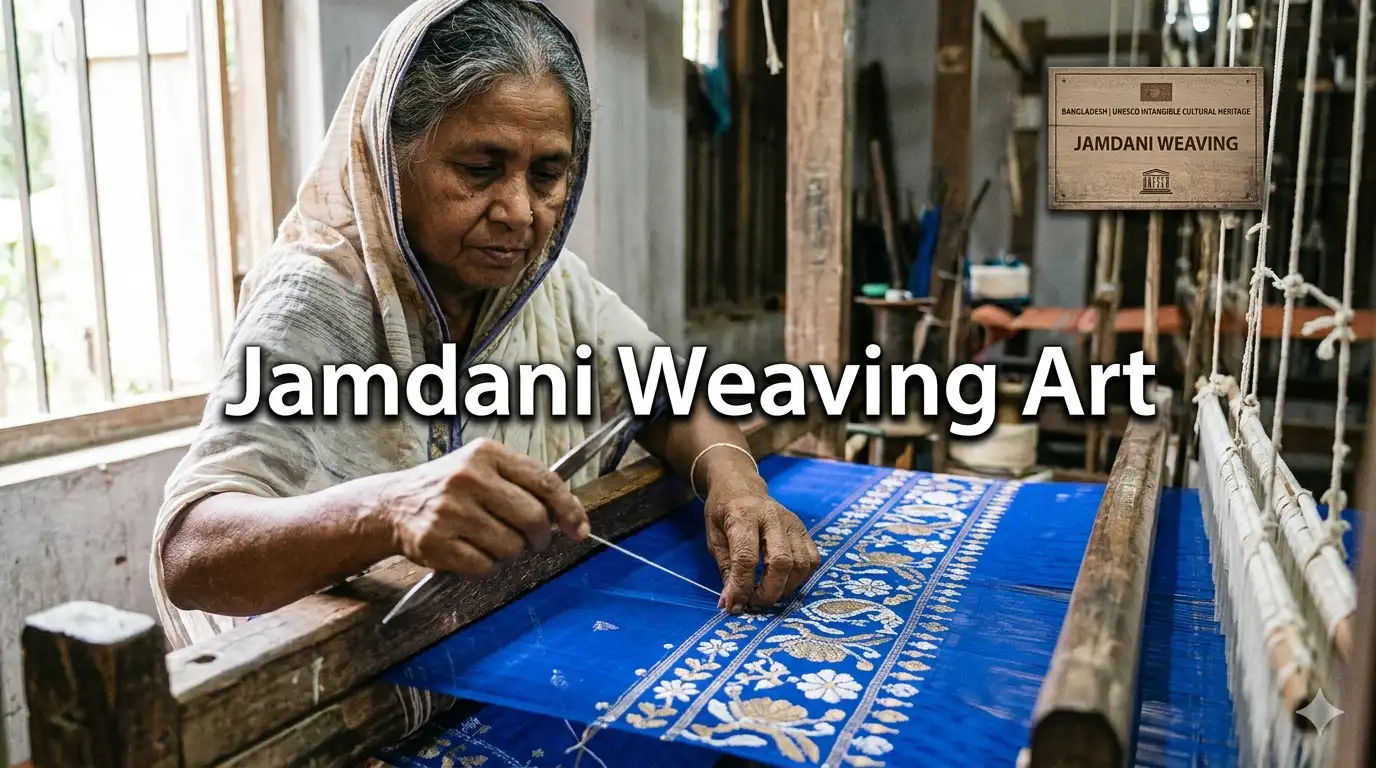
In the quiet villages surrounding Dhaka, where the rhythm of life is dictated by the clatter of wooden looms and the gentle hum of cotton threads, a ancient art form continues to breathe life into fabric. This is the world of Jamdani weaving, a craft so delicate, so intricate, and so ethereal that it was once described by Mughal emperors as "woven air." For centuries, Jamdani has represented the pinnacle of textile craftsmanship in Bengal, embodying not just technical skill but the cultural soul of a region. In 2013, UNESCO recognized this extraordinary heritage by inscribing "Traditional Art of Jamdani Weaving" on the Representative List of the Intangible Cultural Heritage of Humanity, cementing its status as a treasure not just for Bangladesh, but for all of humanity.
But Jamdani is more than a UNESCO tag or a luxury saree draped over shoulders at weddings and celebrations. It is a testament to human patience, artistic vision, and the unbroken chain of knowledge passed from master to apprentice over generations. Each motif woven into the translucent fabric tells a story—of seasons changing, of royal patronage, of colonial decline, and of modern revival. To understand Jamdani is to understand the history of Bengal itself, woven thread by thread into a tapestry of resilience and beauty.
This comprehensive guide unveils the art of Jamdani weaving in all its complexity. You will journey through its storied history from the Mauryan period to the present day, dissect the intricate techniques that make each piece unique, explore the symbolic language of its motifs, and confront the economic and social challenges facing the weavers who keep this tradition alive. Whether you are a textile enthusiast, a cultural historian, a fashion designer, or simply someone who appreciates the beauty of handmade craftsmanship, this exploration will deepen your understanding of why Jamdani remains one of the world's most revered textile arts.
What Is Jamdani? Defining the "Woven Air"
Jamdani is a fine muslin textile on which motifs are woven by hand using a discontinuous weft technique. Unlike printed or embroidered fabrics, where designs are added after the cloth is woven, Jamdani motifs are created during the weaving process itself. This requires extraordinary skill, as the weaver must visualize the pattern and interlace the decorative threads into the warp without the aid of a jacquard mechanism or pre-drawn blueprint.
The Etymology of Jamdani
The word "Jamdani" is believed to have Persian origins, derived from two words:
- "Jam" meaning flower
- "Dani" meaning vase or container
Together, it suggests a container of flowers, reflecting the floral motifs that dominate traditional Jamdani designs. Another theory suggests it comes from "Jama" (cloth) and "Dani" (giver), implying the cloth that gives beauty. Regardless of etymology, the name has become synonymous with the highest quality handloom muslin produced in the Bengal region.
Key Characteristics of Authentic Jamdani
To be classified as true Jamdani, the fabric must possess specific qualities:
- Base Fabric: Traditionally made from fine cotton muslin, though silk and cotton-silk blends are now common
- Translucency: High-quality Jamdani is semi-transparent, allowing light to pass through
- Discontinuous Weft: Motifs are added using separate spools of thread for each color/design element, not continuous across the width
- Handwoven: No mechanical Jacquard looms; every motif is inserted manually by the weaver
- Reversible Patterns: Authentic handloom Jamdani motifs look identical on both sides of the fabric
- Texture: Motifs should be felt slightly raised but integrated into the fabric, not sitting on top like embroidery
Geographical Indication (GI) Status
In 2016, Dhakai Jamdani received Geographical Indication (GI) status from the Government of Bangladesh. This legal protection ensures that only Jamdani produced in specific regions around Dhaka (particularly Sonargaon, Rupganj, and Siddhirganj) using traditional methods can be labeled as "Dhakai Jamdani." This protects the heritage from mass-produced imitations and preserves the authenticity of the craft.
The Historical Tapestry: Origins and Evolution
The history of Jamdani weaving is intertwined with the political and economic history of Bengal. Its rise and fall mirror the fortunes of the regions that patronized it.
Ancient Origins (3rd Century BCE - 12th Century CE)
References to fine muslin weaving in Bengal date back to the Mauryan Empire. The Greek historian Megasthenes (3rd century BCE) mentioned Bengali muslin in his writings. During the Gupta and Pala periods, weaving became a sophisticated industry, with ports in Bengal exporting textiles to Rome, Southeast Asia, and Central Asia. The technique of adding motifs during weaving likely evolved during this period as weavers sought to differentiate their products.
The Golden Age: Mughal Patronage (16th - 18th Century)
Jamdani reached its zenith during the Mughal era. The emperors of Delhi were captivated by the fine muslins of Bengal, often referred to as Malmal or Muslin.
- Imperial Favor: Emperor Akbar established a centralized system for textile production. Jamdani became the preferred fabric for the royal court.
- Naming: Specific varieties were named after nobles or regions (e.g., Ab-e-Rawan meaning "running water," Baft Hawa meaning "woven air").
- Export Boom: Bengal muslin was traded across the Indian Ocean, reaching markets in Europe, Persia, and Indonesia. The Dutch East India Company and British East India Company established trading posts specifically to procure these textiles.
- Technical Mastery: During this period, weavers achieved counts so fine (300-500 count) that the fabric was virtually invisible when laid on grass.
Colonial Decline (18th - 19th Century)
The British colonial period marked a devastating turning point for Jamdani weaving.
- Systematic Destruction: To protect British textile mills, the East India Company imposed high tariffs on Bengali textiles while allowing British manufactured cloth into India duty-free.
- Forced Cultivation: Farmers were forced to grow indigo instead of cotton, reducing raw material availability.
- Physical Repression: Historical accounts suggest weavers were sometimes subjected to physical punishment to prevent them from selling to other traders.
- Industrial Competition: The Industrial Revolution introduced mechanized looms in England that could produce cloth faster and cheaper, albeit with lower quality.
- Result: By the mid-19th century, the Jamdani industry had nearly collapsed. Many weavers abandoned their looms to become farmers or laborers. The knowledge of ultra-fine muslin weaving was largely lost.
Revival and Renaissance (20th Century - Present)
The 20th century saw concerted efforts to revive the craft.
- Swadeshi Movement: During the Indian independence movement, handloom cloth became a symbol of resistance against British manufactured goods.
- Government Support: After the partition of India (1947) and later the independence of Bangladesh (1971), governments established weaving centers and provided subsidies.
- UNESCO Recognition: The 2013 inscription brought global attention and renewed pride.
- Fashion Industry: Contemporary designers have reintroduced Jamdani to global runways, creating new demand.
The Weaving Process: Anatomy of a Masterpiece
Creating a single Jamdani saree is a labor-intensive process that can take anywhere from one month to over a year, depending on the complexity of the design. Understanding the process reveals why authentic Jamdani commands such high prices.
Step 1: Yarn Preparation
Cotton Selection:
- Traditionally, specific varieties of cotton grown along the Meghna River were used for their fineness.
- Today, high-quality cotton yarn is sourced from various regions, though some master weavers still seek out specific counts for authenticity.
Spinning and Sizing:
- Yarn is spun to the desired thickness (count).
- It is then treated with starch (sizing) to strengthen it for weaving.
- Yarn is wound onto bobbins for the warp (lengthwise threads) and weft (widthwise threads).
Step 2: Loom Setup (Tana)
The Traditional Loom:
- Jamdani is woven on a traditional wooden pit loom.
- The weaver sits below ground level, with the warp threads stretched horizontally at ground level.
- This setup allows the weaver to use their feet to operate pedals that lift specific warp threads, creating a "shed" through which the weft is passed.
Warping:
- Setting up the warp is critical. Thousands of threads must be aligned perfectly parallel.
- Any tension inconsistency will result in flaws in the final fabric.
Step 3: Weaving the Base (Pohen)
Plain Weave:
- The base fabric is woven first using a plain weave technique.
- This creates the translucent muslin background.
- Speed is relatively fast compared to motif weaving.
Step 4: Adding Motifs (The Jamdani Technique)
This is the heart of Jamdani weaving and what distinguishes it from other textiles.
Discontinuous Weft Method:
- Unlike standard weaving where the weft thread goes from one edge of the fabric to the other, Jamdani weavers use small spools (kandi) for each motif.
- The weaver manually interlaces the decorative thread into the warp only where the design requires it.
- This means a single row of weaving might involve dozens of separate thread insertions.
The Role of the Ustad (Master Weaver):
- The design exists in the master weaver's mind, not on paper.
- The ustad guides the assistants, calling out where each motif should be placed.
- This oral transmission of design knowledge is a key part of the intangible heritage.
Assistant Weavers:
- A typical loom has one master weaver and 2-3 assistants.
- Assistants handle the spools and pass threads to the master.
- Coordination must be perfect to maintain pattern symmetry.
Step 5: Finishing
- Once weaving is complete, the saree is cut from the loom.
- It is washed to remove starch and sizing.
- Some Jamdanis are lightly calendered (pressed) to enhance sheen.
- No chemical processing is done on authentic handloom Jamdani.
The Language of Motifs: Symbolism and Design
Jamdani motifs are not random decorations; they are a visual language rooted in Bengali culture, nature, and history. Over centuries, a standardized vocabulary of designs has emerged.
Floral Motifs (The Most Common)
Buti/Buta:
- Small floral sprays scattered across the fabric.
- Symbolize prosperity and growth.
- Often used as filler patterns between larger motifs.
Kalka (Paisley):
- The iconic mango-shaped motif.
- Represents fertility, life, and eternity.
- One of the most recognizable Jamdani designs.
Genda Phool (Marigold):
- Depicts the marigold flower, common in Bengali households.
- Symbolizes auspiciousness and is often used in wedding sarees.
Bel (Creeper):
- Continuous vine-like pattern running along the border or across the body.
- Represents continuity and eternal life.
Geometric Motifs
Charkona:
- Four-cornered diamond or square shapes.
- Represents stability and balance.
Tilli:
- Small dot-like patterns.
- Often used to create texture and depth.
Jhaler:
- Fringe-like patterns typically found on the border.
- Mimics the look of hanging bells or decorative edges.
Natural and Celestial Motifs
Chand Tara:
- Moon and stars.
- Represents cosmic harmony and beauty.
Mayur (Peacock):
- Depicts the peacock, a symbol of grace and beauty.
- Technically challenging to weave due to intricate details.
Pata (Leaf):
- Various leaf patterns inspired by local vegetation.
- Symbolizes nature and renewal.
Modern Adaptations
Contemporary designers are expanding the motif vocabulary:
- Architectural elements: Incorporating designs from mosques, temples, and colonial buildings.
- Abstract art: Modern geometric and abstract patterns.
- Portraits: Extremely advanced weavers can now weave human faces and landscapes.
- Logos and Text: Custom Jamdani for corporate gifts or special events.
UNESCO Recognition: What It Means for Jamdani
In 2013, UNESCO inscribed "Traditional Art of Jamdani Weaving" on the Representative List of the Intangible Cultural Heritage of Humanity. This was a watershed moment for the craft.
Criteria for Inscription
Jamdani met several key criteria for UNESCO recognition:
- Transmission: Knowledge is passed orally and through demonstration from master to apprentice.
- Community Identity: Provides communities with a sense of identity and continuity.
- Creativity: Demonstrates human creative spirit and cultural diversity.
- Compatibility: Compatible with existing international human rights instruments.
Impact of UNESCO Status
Global Awareness:
- Put Jamdani on the global cultural map.
- Increased interest from international collectors and museums.
Government Commitment:
- Bangladesh government committed to safeguarding the craft.
- Increased funding for weaving centers and training programs.
- Legal protection through GI status followed.
Weaver Pride:
- Boosted morale among weaving communities.
- Younger generation more willing to learn the craft.
- Increased bargaining power for authentic weavers.
Tourism:
- Weaving villages near Dhaka became cultural tourism destinations.
- Visitors can observe the weaving process firsthand.
The Human Element: Lives of the Weavers
Behind every Jamdani saree are the hands and lives of the weavers. Understanding their reality is crucial to appreciating the true cost of the fabric.
The Weaving Communities
Jamdani weaving is concentrated in specific villages around Dhaka:
- Sonargaon: The historical capital, heart of Jamdani production.
- Rupganj: Large cluster of looms and weaving households.
- Siddhirganj: Known for specific varieties of Jamdani.
- Tara Bazar: Market hub where Jamdani is traded.
These communities have woven for generations. Knowledge is inherited, with sons learning from fathers. The loom is often set up in the weaver's home, making it a cottage industry.
Economic Realities
Income Instability:
- Weavers are typically paid per piece, not per hour.
- Complex designs take months, delaying payment.
- Seasonal fluctuations in demand affect income.
Middlemen (Beopari):
- Most weavers do not sell directly to consumers.
- Traders provide yarn and advance payments, then sell the finished product.
- Weavers often receive only 20-30% of the final retail price.
- Dependency on traders for raw materials creates debt cycles.
Working Conditions:
- Long hours (10-12 hours daily) hunched over looms.
- Poor ventilation in weaving sheds.
- Health issues: Back pain, eye strain, respiratory problems from cotton dust.
- Lack of social security or health insurance.
Challenges Facing the New Generation
- Education vs. Tradition: Younger generations are educated and often seek office jobs rather than weaving.
- Low Wages: Daily earnings often fall below living wage standards.
- Lack of Innovation: Traditional designs may not appeal to younger consumers.
- Competition: Power loom imitations undercut handloom prices.
Authentic vs. Imitation: How to Identify Real Jamdani
With popularity comes imitation. The market is flooded with power-loom copies that look similar but lack the soul and value of handloom Jamdani. Here's how to tell the difference.
Visual Inspection
1. Check the Reverse Side:
- Handloom: Motifs look identical on both sides.
- Power Loom/Print: Motifs may be faded, incomplete, or non-existent on the reverse.
2. Examine the Motif Edges:
- Handloom: Edges are slightly irregular due to manual insertion.
- Power Loom: Edges are perfectly uniform and mechanical.
3. Look for Discontinuous Weft:
- Handloom: You can see where individual motif threads start and end.
- Power Loom: Threads often run continuously across the width.
4. Translucency Test:
- Handloom: Hold against light; genuine muslin is semi-transparent.
- Imitation: Often thicker, less transparent due to synthetic blends.
Tactile Inspection
1. Feel the Texture:
- Handloom: Motifs are integrated into the fabric; slight texture variation.
- Embroidery/Print: Motifs sit on top of the fabric or feel smooth like print.
2. Check the Weight:
- Handloom: Lightweight, breathable.
- Imitation: Often heavier due to synthetic fibers.
Price Indicators
- Handloom Jamdani: Typically starts from ৳10,000 BDT ($100 USD) and can go up to ৳500,000+ BDT ($5,000+ USD) for masterpieces.
- Power Loom: Usually ৳2,000-৳8,000 BDT ($20-$80 USD).
- Warning: If the price seems too good to be true, it likely is.
Certification and Labels
- Look for the GI tag label.
- Purchase from reputable sellers or government-approved outlets (e.g., Aarong, Kumudini, Bangladesh Handloom Board).
- Ask for a certificate of authenticity for high-value pieces.
Challenges and Threats to the Heritage
Despite UNESCO recognition, Jamdani faces existential threats that require urgent attention.
1. Power Loom Imitations
Mechanized looms can produce Jamdani-like patterns in hours instead of months. These imitations flood the market at a fraction of the cost, confusing consumers and undercutting genuine weavers. Many buyers cannot distinguish between handloom and power loom, opting for the cheaper option.
2. Raw Material Shortages
High-quality cotton yarn suitable for fine Jamdani is becoming harder to source. Traditional cotton varieties are no longer grown extensively. Reliance on imported yarn increases costs and vulnerability to global market fluctuations.
3. Lack of Design Innovation
While traditional motifs are beautiful, younger consumers often seek contemporary designs. The weaving community is sometimes resistant to change, sticking to centuries-old patterns that may not align with modern fashion trends.
4. Climate Change
Jamdani weaving requires specific humidity levels. Extreme weather events, flooding, and changing humidity patterns in Bangladesh affect the weaving process and the quality of the cotton.
5. Economic Exploitation
The middleman system remains prevalent. Weavers lack direct market access and bargaining power. Without fair wages, the next generation has little incentive to continue the craft.
Preservation and Revival Efforts
Various stakeholders are working to safeguard Jamdani for the future.
Government Initiatives
- Bangladesh Handloom Board: Provides training, subsidies, and marketing support.
- Jamdani Palli: Dedicated weaving villages with improved infrastructure.
- Legal Protection: GI status and anti-counterfeiting laws.
- Exhibitions: National and international trade fairs to promote Jamdani.
NGO and Private Sector Role
- Aarong: Fair trade organization that connects weavers directly to consumers, ensuring fair wages.
- Designers: Contemporary fashion designers incorporating Jamdani into modern garments (gowns, shirts, accessories).
- Training Centers: NGOs running schools to teach weaving to young people.
International Collaboration
- UNESCO Projects: Funding for documentation and safeguarding plans.
- Museum Partnerships: Exhibitions in Victoria & Albert Museum (London), Metropolitan Museum of Art (New York), etc.
- Research: Academic studies on weaving techniques and history to preserve knowledge.
Jamdani in Contemporary Fashion
Jamdani is no longer confined to traditional sarees. The fabric is finding new life in modern fashion.
Global Runways
International designers have featured Jamdani in fashion weeks in Paris, London, and New York. This global exposure elevates the craft from "ethnic wear" to "luxury fashion," commanding higher prices and respect.
Product Diversification
Beyond sarees, Jamdani is now used for:
- Scarves and Stoles: More affordable entry point for buyers.
- Shirts and Kurtas: Men's fashion incorporating Jamdani motifs.
- Home Decor: Cushion covers, table runners, wall hangings.
- Accessories: Bags, shoes, and jewelry incorporating Jamdani fabric.
Fusion Designs
Designers are blending Jamdani with other fabrics (silk, chiffon) and techniques (embroidery, block print) to create fusion wear that appeals to younger generations while maintaining the core weaving technique.
Economic Impact and Market Potential
Jamdani is not just culture; it's an economic engine.
Export Potential
There is significant untapped potential in export markets. High-end consumers in Europe, North America, and Asia value handmade, ethical fashion. Proper branding and certification could unlock millions in export revenue.
Employment Generation
The Jamdani industry supports hundreds of thousands of livelihoods directly (weavers) and indirectly (yarn suppliers, dyers, traders, retailers). Revitalizing the sector creates rural employment and reduces urban migration.
Tourism Integration
Cultural tourism centered around Jamdani weaving villages can generate additional income. Visitors pay to watch weaving, buy directly from weavers, and experience the cultural context.
How to Support Jamdani Weaving
As a consumer, you can play a role in preserving this heritage.
Buy Authentic
Invest in genuine handloom Jamdani. Understand that the high price reflects months of labor. Avoid cheap imitations that undermine the craft.
Ask Questions
Ask sellers about the origin, weaving time, and weaver details. Educated consumers demand transparency, which pressures the market toward authenticity.
Spread Awareness
Share knowledge about Jamdani with friends and family. Post about authentic pieces on social media. Tag weavers and ethical brands.
Support Ethical Brands
Choose brands that practice fair trade and ensure weavers receive fair wages. Look for transparency in the supply chain.
Preserve and Care
Treat Jamdani as an heirloom. Proper care ensures it lasts for generations, continuing its story.
Caring for Your Jamdani: Maintenance Tips
Jamdani is delicate and requires special care to maintain its beauty.
Washing
- Dry Clean: Recommended for expensive or heavily worked Jamdani.
- Hand Wash: If washing at home, use mild detergent and cold water.
- Avoid: Harsh chemicals, bleach, or vigorous scrubbing.
- Drying: Dry in shade; direct sunlight can fade colors and weaken fibers.
Storage
- Folding: Fold loosely to avoid creasing motifs.
- Wrapping: Wrap in soft cotton cloth; avoid plastic which traps moisture.
- Environment: Store in cool, dry place. Use neem leaves or cedar to prevent insects.
- Airing: Unfold and air occasionally to prevent mustiness.
Wearing
- Jewelry: Avoid sharp jewelry that can snag threads.
- Perfume: Apply perfume before wearing to avoid direct contact with fabric.
- Rotation: Don't wear the same Jamdani frequently; give fibers time to recover.
Frequently Asked Questions
How long does it take to weave a Jamdani saree?
It depends on complexity: - Simple designs: 1-3 months - Medium complexity: 3-6 months - Masterpiece (high motif density): 6 months to 1+ year A team of 2-4 weavers typically works on one loom simultaneously.
Why is Jamdani so expensive?
You are paying for: - Time: Months of skilled labor - Skill: Generations of knowledge - Material: High-quality cotton or silk - Uniqueness: Each piece is one-of-a-kind - Heritage: Preservation of cultural heritage Compared to machine-made cloth, the value is in the human artistry, not just the fabric.
Can Jamdani be machine washed?
Generally, no. Handloom Jamdani is delicate. Machine washing can damage motifs, cause shrinkage, or fade colors. Dry cleaning or gentle hand washing is recommended. Always check care instructions from the seller.
What is the difference between Jamdani and Banarasi?
- Jamdani: Motifs woven during weaving (discontinuous weft), typically cotton or cotton-silk, lighter, translucent. - Banarasi: Often uses brocade technique (continuous weft), typically silk with gold/silver zari, heavier, more opaque. Both are prestigious Indian subcontinent textiles but differ in technique and appearance.
Where can I buy authentic Jamdani?
- In Bangladesh: Sonargaon weaving villages, Aarong, Kumudini, Bangladesh Handloom Board outlets, reputable shops in New Market/Dhanmondi. - Internationally: Ethical fashion retailers, museum shops, specialized textile galleries. - Online: Verified sellers with GI certification and transparency about weavers. Always ask for authenticity certificates for high-value purchases.
Is Jamdani only for women?
No. While sarees are the most common product, Jamdani fabric is used for men's kurtas, shirts, scarves, and home decor. The fabric itself is gender-neutral; it's the garment style that varies.
Conclusion: Preserving the Woven Air for Future Generations
The art of Jamdani weaving is more than a textile technique; it is a living heritage that connects us to centuries of history, culture, and human creativity. Each thread carries the weight of tradition, and each motif tells a story of resilience. From the royal courts of the Mughals to the UNESCO halls of Paris, Jamdani has survived empires, colonization, and industrialization. But its future is not guaranteed.
The survival of Jamdani depends on a collective effort. Weavers need fair wages and recognition. Consumers need education and willingness to invest in authenticity. Governments need to enforce protections and support infrastructure. Designers need to innovate while respecting tradition. And all of us need to recognize that handmade heritage is not a commodity to be cheapened, but a legacy to be cherished.
Key takeaways about Jamdani weaving:
- UNESCO Heritage: Recognized globally as an intangible cultural heritage of humanity
- Handwoven Mastery: Discontinuous weft technique requires immense skill and patience
- Cultural Symbol: Motifs reflect Bengali nature, culture, and history
- Economic Challenge: Weavers face exploitation and competition from power looms
- Consumer Power: Buying authentic supports preservation and fair livelihoods
- Future Outlook: Depends on balancing tradition with innovation and fair trade
When you drape a Jamdani saree, you are not just wearing fabric. You are wearing history. You are wearing the dreams of weavers who sit below ground level, threading hope into cotton. You are wearing a piece of "woven air" that has survived centuries.
Let us ensure it survives centuries more.
Support the weavers. Choose authenticity. Celebrate the art. The loom is still clattering in the villages around Dhaka. The threads are still being woven. The art is still alive. It is up to us to ensure it continues to breathe.
Welcome to the world of Jamdani—where every thread tells a story, and every saree is a masterpiece.