

The Secret to Effortless Weight Loss: Mastering Portion Control Without Counting Calories
The Calorie-Counting Trap Why Simplicity Wins for Sustainable Weight Loss
For decades, weight loss advice has centered on one principle: calories in, calories out. Track your intake, stay under a specific number, and watch the pounds melt away. While this logic is scientifically sound in theory, the reality for most people is far more complex—and far less sustainable.
Calorie counting, while precise, comes with significant drawbacks:- Mental burden: Constant tracking can lead to decision fatigue, anxiety, and an obsessive relationship with food- Inaccuracy: Food labels and apps often have margins of error; homemade meals are especially difficult to quantify- Sustainability: Studies show most people abandon calorie tracking within weeks or months- Missing the bigger picture: Focusing solely on numbers can overlook food quality, satiety, and overall health
The alternative? A more intuitive, sustainable approach: mastering portion control without counting calories.
Portion control isn't about restriction or deprivation. It's about developing awareness, using simple visual cues, and making strategic choices that naturally align your intake with your body's needs. When done thoughtfully, this approach can lead to effortless weight loss—without the stress of constant tracking.
This guide explores the science and strategy behind portion control that works. You'll learn practical, evidence-based techniques to manage portions intuitively, create satisfying meals that support your goals, and build habits that last. Whether you're seeking to lose weight, maintain a healthy weight, or simply develop a more balanced relationship with food, these strategies offer a path forward that honors both your body and your life.
The Science of Satiety Why Portion Control Works
To understand why portion control is effective, we first need to understand how your body regulates hunger and fullness.
The Role of Stomach Stretch ReceptorsYour stomach contains stretch receptors that signal fullness to your brain. When you eat, these receptors detect the volume of food and send "I'm full" messages via the vagus nerve. This is why eating larger volumes of low-calorie, high-fiber foods (like vegetables) can promote satiety with fewer calories.
Hormonal Signals: Ghrelin and LeptinTwo key hormones regulate appetite:- Ghrelin: The "hunger hormone" that increases before meals and decreases after eating- Leptin: The "satiety hormone" produced by fat cells that signals long-term energy stores
Portion control supports healthy hormonal balance by:- Preventing overeating that can blunt leptin sensitivity over time- Allowing ghrelin to follow its natural rhythm rather than being constantly suppressed by frequent snacking- Supporting stable blood sugar, which influences both hormones
The Impact of Eating SpeedIt takes approximately 20 minutes for your brain to register fullness after you start eating. When you eat quickly:- You may consume more calories before satiety signals arrive- Digestion can be compromised, leading to discomfort- You miss the opportunity to enjoy and savor your food
Slower eating, often a natural result of mindful portion control, supports better digestion, greater satisfaction, and reduced overall intake.
Visual Portion Guides Your Hands as Tools
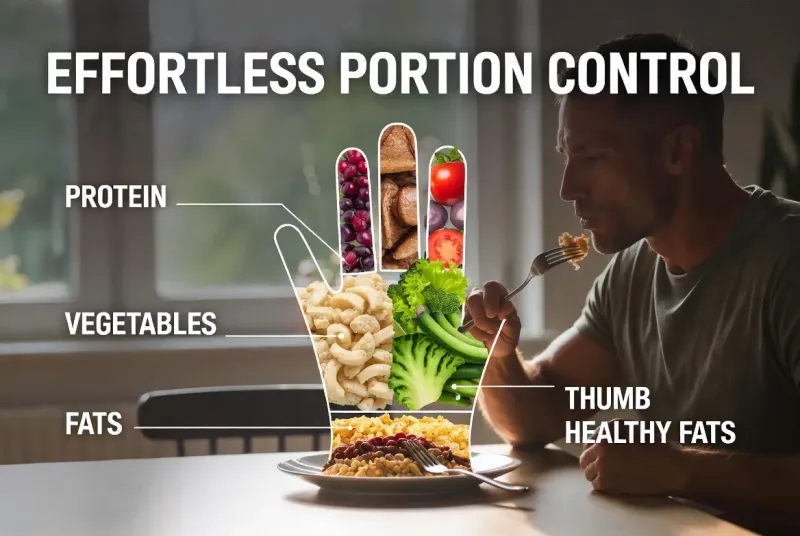
One of the most practical, portable portion control strategies is using your hands as visual guides. This method is intuitive, requires no equipment, and adapts to your individual body size.
The Hand Portion Method
Protein: Palm-Sized Portions- Visual cue: A portion of protein (chicken, fish, tofu, beans) roughly the size and thickness of your palm (excluding fingers)- Why it works: Protein is highly satiating and supports muscle maintenance during weight loss- Typical amount: 20-30g protein per meal for most adults- Application: Use your palm to estimate portions when cooking, dining out, or packing meals
Vegetables: Fist-Sized or More- Visual cue: Non-starchy vegetables (leafy greens, broccoli, peppers, zucchini) equal to one or two closed fists- Why it works: Vegetables are low in calories but high in volume, fiber, and nutrients—promoting fullness with minimal calories- Typical amount: 1-2 cups per meal- Application: Fill half your plate with vegetables using your fist as a guide
Carbohydrates: Cupped Hand Portions- Visual cue: Starchy carbs (rice, pasta, potatoes, oats) equal to one cupped hand- Why it works: Carbs provide energy, but portion awareness helps manage calorie density- Typical amount: 15-30g carbs per cupped hand, depending on the food- Application: Use your cupped hand to estimate grains, legumes, or starchy vegetables
Fats: Thumb-Sized Portions- Visual cue: Healthy fats (olive oil, nut butter, avocado, cheese) equal to the size of your thumb- Why it works: Fats are calorie-dense (9 calories per gram vs. 4 for protein/carbs); small portions provide flavor and satiety without excess calories- Typical amount: 1 tablespoon oil, 2 tablespoons nut butter, or 1/4 avocado- Application: Measure fats with your thumb when cooking or adding to meals
Why This Method Works- Personalized: Your hand size generally correlates with your body size and energy needs- Portable: No apps, scales, or measuring cups required- Flexible: Adapts to different meals, cuisines, and settings- Sustainable: Builds intuitive awareness rather than rigid rules
The Plate Method Building Balanced Meals Visually
Another powerful visual strategy is the plate method, which guides meal composition without counting.
The Balanced Plate Framework
Divide your plate (approximately 9-10 inches in diameter) into three sections:- Half plate: Non-starchy vegetables (salad, roasted veggies, steamed greens)- Quarter plate: Lean protein (chicken, fish, eggs, tofu, legumes)- Quarter plate: Quality carbohydrates (whole grains, starchy vegetables, fruit)
Add a small portion of healthy fats (thumb-sized) and hydrate with water or unsweetened beverages.
Why This Works- Naturally limits calorie density: Vegetables fill volume with minimal calories- Balances macronutrients: Supports satiety, energy, and nutrient intake- Simplifies decision-making: No need to calculate; just fill your plate intentionally- Adaptable: Works for any cuisine or dietary preference
Practical Application- At home: Use a smaller plate to naturally reduce portions without feeling deprived- Dining out: Visualize the plate divisions before ordering; ask for sauces/dressings on the side- Meal prep: Pre-portion plates using the framework to streamline healthy choices
Mindful Eating The Mental Component of Portion Control
Portion control isn't just about physical cues; it's also about mindset. Mindful eating practices enhance your ability to recognize hunger and fullness, reducing the likelihood of overeating.
Key Mindful Eating Practices
1. Pause Before Eating- Take three deep breaths before your first bite- Acknowledge your hunger level on a scale of 1-10- Set an intention: "I will eat slowly and notice when I'm satisfied"
2. Eliminate Distractions- Turn off screens, put away phones, and focus on your meal- Eating while distracted can lead to consuming 10-15% more calories without realizing it
3. Chew Thoroughly- Aim for 20-30 chews per bite- This slows your pace, enhances digestion, and allows satiety signals to register
4. Check In Mid-Meal- Pause halfway through your meal- Assess your fullness: Are you still hungry, satisfied, or approaching full?- Give yourself permission to stop when comfortably full, not stuffed
5. Savor the Experience- Notice flavors, textures, and aromas- Appreciating your food increases satisfaction, reducing the urge to overeat
The Environmental Factor How Your Surroundings Influence Portions
Your environment subtly shapes how much you eat. Small adjustments can support portion control without conscious effort.
Strategies for Portion-Friendly Environments
At Home- Use smaller plates and bowls: Research shows people serve and eat less with smaller dishware- Pre-portion snacks: Instead of eating from a large bag, portion nuts, crackers, or chips into small containers- Keep healthy foods visible: Place fruits, vegetables, and water at eye level; store treats out of immediate sight- Serve meals in the kitchen: Avoid placing serving dishes on the table to reduce second helpings
Dining Out- Review the menu online beforehand: Decide on a balanced option before hunger influences choices- Ask for a to-go box when your meal arrives: Portion out half to save for later before you start eating- Share entrees: Split a main course with a friend or order an appetizer as your main- Request sauces and dressings on the side: Control the amount you consume
Social Settings- Eat a small, balanced snack before events: Arriving overly hungry increases the likelihood of overeating- Focus on conversation: Shift attention from food to connection- Practice the "one-plate rule": Fill one balanced plate and avoid returning for seconds unless truly hungry
Navigating Hunger and Fullness Cues
A cornerstone of intuitive portion control is learning to recognize and respond to your body's natural signals.
Understanding Hunger vs. Appetite- Physical hunger: Develops gradually, felt in the stomach, accompanied by low energy or mild irritability- Emotional appetite: Sudden, specific cravings, often triggered by stress, boredom, or habits
Strategies to Tune Into Hunger Cues- Rate your hunger before eating: Use a 1-10 scale (1=starving, 10=stuffed); aim to eat when at 3-4- Identify triggers: Notice if you're eating due to hunger or external cues (time of day, seeing food, emotions)- Practice the "apple test": If you're unsure whether you're hungry, ask: "Would I eat an apple right now?" If yes, you're likely physically hungry
Recognizing Fullness- Stop at "comfortably full": Aim for a 7 on the 1-10 fullness scale—satisfied but not stuffed- Notice physical cues: Slowing pace, decreased interest in food, feeling of satisfaction- Honor your fullness: It's okay to leave food on your plate; you can always eat it later if truly hungry
Strategic Food Choices Supporting Portion Control Through Quality
What you eat influences how much you naturally want to eat. Certain food qualities promote satiety and reduce the likelihood of overeating.
Prioritize Protein- Why: Protein is the most satiating macronutrient, reducing hunger hormones and increasing fullness signals- Application: Include a palm-sized portion of protein at each meal- Examples: Greek yogurt, eggs, chicken, fish, tofu, lentils, cottage cheese
Embrace Fiber-Rich Foods- Why: Fiber adds volume without calories, slows digestion, and stabilizes blood sugar- Application: Fill half your plate with non-starchy vegetables; choose whole grains over refined- Examples: Broccoli, berries, oats, beans, chia seeds, leafy greens
Choose Whole, Minimally Processed Foods- Why: Whole foods require more chewing, digest more slowly, and provide greater nutrient density- Application: Build meals around ingredients you recognize; limit ultra-processed snacks- Examples: Fresh fruit vs. fruit snacks; homemade soup vs. canned with additives
Mind Liquid Calories- Why: Beverages don't trigger the same satiety signals as solid food; calories from drinks can add up quickly- Application: Prioritize water, herbal tea, or black coffee; limit sugary drinks, alcohol, and high-calorie coffee beverages- Tip: Drink a glass of water before meals to support portion awareness
Managing Challenges Portion Control in Real Life
Even with the best strategies, real-world situations can test your portion control. Here's how to navigate common challenges.
Emotional Eating- Recognize the trigger: Stress, boredom, sadness, or celebration can prompt eating beyond hunger- Create a pause: When the urge arises, wait 10 minutes and engage in a non-food activity (walk, journal, call a friend)- Practice self-compassion: If you do eat emotionally, acknowledge it without judgment and return to your intentions at the next meal
Restaurant Portions- Problem: Restaurant servings are often 2-4 times larger than appropriate portions- Strategies:andnbsp; • Order an appetizer as your main courseandnbsp; • Ask for a half-portion or children's menu optionandnbsp; • Immediately box half your meal to take homeandnbsp; • Share an entree with a dining companion
Social Pressure- Problem: Well-meaning friends or family may encourage larger portions or second helpings- Strategies:andnbsp; • Prepare a polite, confident response: "This is perfect, thank you!"andnbsp; • Focus on connection: Shift attention from food to conversationandnbsp; • Bring a balanced dish to share: Ensure there's a portion-controlled option available
Travel and Busy Days- Problem: Irregular schedules and limited food access can lead to impulsive, oversized portions- Strategies:andnbsp; • Pack portable, portioned snacks: Nuts, fruit, protein barsandnbsp; • Use the hand-portion method when dining outandnbsp; • Stay hydrated: Thirst can mimic hunger, especially during travel
Building Sustainable Habits The Long Game
Portion control isn't a short-term fix; it's a lifelong skill. Building sustainable habits requires patience, self-compassion, and consistency.
Start Small- Choose one strategy to implement this week: Perhaps using your hand to estimate protein portions or practicing mindful eating at one meal per day- Master that skill before adding another: Sustainable change happens incrementally
Track Progress Beyond the Scale- Notice non-scale victories: Increased energy, better sleep, clothes fitting differently, improved digestion- Celebrate consistency: Acknowledge showing up for your health, not just outcomes
Embrace Flexibility- Allow for variation: Some days you'll eat more; some days less. That's normal and healthy- Focus on patterns, not perfection: One oversized meal won't derail progress; consistent habits will drive results
Revisit and Adjust- As your body changes, your needs may shift: Regularly check in with your hunger cues and adjust portions accordingly- Stay curious: If a strategy isn't working, experiment with alternatives rather than abandoning the approach
When to Seek Professional Guidance
While portion control is a powerful tool for most people, certain situations benefit from personalized support. Consider consulting a registered dietitian or healthcare provider if:- You have a history of disordered eating or restrictive dieting- You experience persistent hunger, fatigue, or other symptoms despite balanced eating- You have medical conditions affecting nutrition (diabetes, thyroid disorders, gastrointestinal issues)- You want personalized guidance tailored to your goals, preferences, and lifestyle
A professional can help you:- Develop a portion control plan aligned with your unique needs- Address underlying factors affecting appetite or weight- Integrate portion strategies with medical or therapeutic care when needed
The Bigger Picture Weight Loss as Part of Whole-Person Wellness
While achieving a healthy weight is a common goal, it's essential to maintain perspective
Health Markers Matter More Than Numbers- Blood pressure, blood sugar, cholesterol, and inflammation markers reflect metabolic health more accurately than body weight alone- Energy levels, sleep quality, and mood are meaningful indicators of wellness- Mental health and quality of life are central to overall well-being
Avoiding Extremes- Over-restriction can lead to binge cycles, nutrient deficiencies, and metabolic adaptation- Sustainable portion control supports long-term health more effectively than quick fixes- Balance, not perfection, is the goal
Conclusion Effortless Weight Loss Through Intention, Not Deprivation
If the idea of counting calories feels overwhelming, remember: you don't need to track every bite to achieve meaningful, lasting results. Portion control—guided by visual cues, mindful eating, and strategic food choices—offers a simpler, more sustainable path forward.
Understanding the science behind satiety, hunger cues, and environmental influences empowers you to work with your body, not against it. You don't need perfection. You need consistency, self-compassion, and practical strategies that fit your life.
Start where you are. Choose one technique from this guide to implement this week—perhaps using your hand to estimate portions, practicing mindful eating at one meal, or adjusting your plate composition. Notice how you feel. Build from there.
Your relationship with food is a journey, not a destination. With informed, compassionate habits, you can cultivate a balanced approach that supports your health, honors your body, and fits seamlessly into your life.
For evidence-based nutrition resources, practical tools, and expert guidance to support your wellness journey, explore trusted platforms that prioritize science, transparency, and individualized care. Your path to sustainable health starts with one intentional choice at a time.