

Top Tech Trends of 2026: AI, Automation, Robotics and Beyond
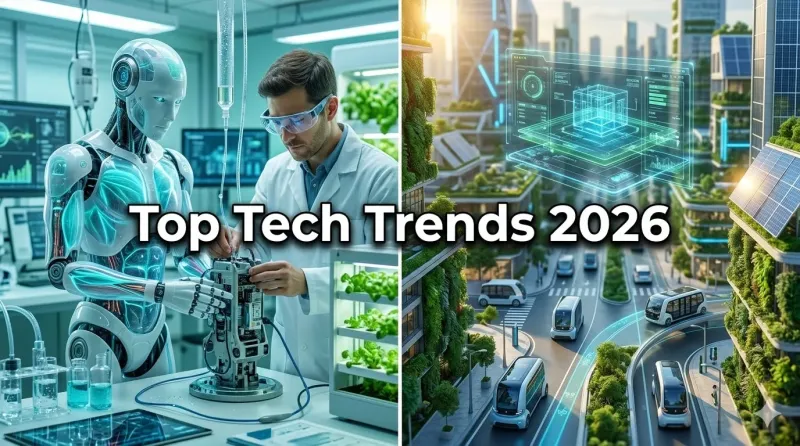
As we navigate through 2026, the technology landscape is evolving at an unprecedented pace. Artificial intelligence, automation, and robotics are no longer futuristic concepts—they're reshaping industries, redefining work, and transforming how we live, work, and connect. For entrepreneurs, business leaders, and tech enthusiasts, understanding these trends isn't just interesting; it's essential for staying competitive and making informed decisions about the future.
This comprehensive guide explores the top tech trends of 2026, diving deep into AI advancements, automation breakthroughs, robotics innovations, and emerging technologies that are defining this pivotal year. You'll discover practical applications, real-world examples, and actionable insights to help you leverage these trends for personal growth, business success, or simply staying informed in a rapidly changing world.
Whether you're a startup founder evaluating new tools, a corporate leader planning digital transformation, or a curious individual exploring what's next, this guide will equip you with the knowledge to navigate the tech-driven future. Let's explore what's shaping technology in 2026—and how you can harness these innovations for meaningful impact.
The AI Revolution: Beyond Chatbots to Intelligent Systems
Artificial intelligence has moved far beyond simple chatbots and recommendation engines. In 2026, AI is becoming deeply integrated into business processes, creative workflows, and decision-making systems in ways that are both powerful and practical.
Agentic AI: Autonomous Systems That Take Action
What It Is: Agentic AI refers to artificial intelligence systems that can plan, execute, and complete multi-step tasks with minimal human intervention. Unlike traditional AI that responds to prompts, agentic AI can break down complex goals, make decisions, and take actions across different platforms and tools.
Key Developments in 2026:
- Multi-agent collaboration: Multiple AI agents working together to solve complex problems, with one agent handling research, another handling analysis, and another handling execution
- Tool integration: AI agents that can use software tools, APIs, and databases autonomously to complete tasks like booking travel, managing projects, or analyzing data
- Memory and context: Long-term memory systems allowing AI to remember user preferences, past interactions, and project history for more personalized assistance
- Safety guardrails: Improved frameworks for ensuring AI agents act within defined boundaries and escalate uncertain decisions to humans
Practical Applications:
- Business operations: AI agents that manage email triage, schedule meetings, prepare reports, and follow up on action items
- Customer service: Autonomous agents that resolve complex customer issues by accessing multiple systems and making decisions within policy guidelines
- Research and analysis: AI that can conduct literature reviews, synthesize findings, and draft initial reports with minimal human direction
- Personal productivity: Personal AI assistants that manage calendars, prioritize tasks, and proactively suggest optimizations to your workflow
What This Means for You: Start thinking about tasks that could be delegated to autonomous AI systems. Identify repetitive, multi-step processes in your work or business that could benefit from agentic AI. Begin with small pilots to test effectiveness and build trust before scaling.
Small Language Models (SLMs): Efficient, Specialized AI
What It Is: While large language models (LLMs) like GPT-4 get most of the attention, 2026 is seeing a surge in small language models—compact, efficient AI systems trained for specific tasks or domains.
Why SLMs Matter in 2026:
- Cost efficiency: SLMs require less computing power, making them cheaper to run and easier to deploy on edge devices
- Speed: Faster inference times enable real-time applications like voice assistants or on-device translation
- Privacy: SLMs can run locally on devices, keeping sensitive data private rather than sending it to cloud servers
- Specialization: Models trained on specific domains (legal, medical, technical) often outperform general-purpose models for specialized tasks
Real-World Examples:
- Healthcare: SLMs trained on medical literature assisting doctors with diagnosis support while running on hospital servers for data privacy
- Legal tech: Specialized models that review contracts, identify risks, and suggest revisions with domain-specific accuracy
- Manufacturing: On-device AI that monitors equipment, predicts maintenance needs, and optimizes production without cloud dependency
- Mobile apps: Offline-capable AI features in smartphones for translation, photo editing, and voice commands
Implementation Strategy: Evaluate whether your use case requires a general-purpose LLM or could benefit from a specialized SLM. For tasks with clear domain boundaries and privacy requirements, SLMs often provide better performance at lower cost.
AI-Human Collaboration: Augmentation, Not Replacement
The Shift: The narrative around AI is evolving from "AI will replace humans" to "AI will augment human capabilities." In 2026, the most successful applications focus on enhancing human creativity, judgment, and expertise rather than automating them away.
Key Collaboration Patterns:
- Copilot models: AI assistants that work alongside humans, offering suggestions, catching errors, and handling routine aspects of complex tasks
- Iterative refinement: Humans and AI working in loops—AI generates drafts or options, humans refine and direct, AI learns from feedback
- Explainable AI: Systems that don't just provide answers but explain their reasoning, enabling humans to validate and trust AI outputs
- Human-in-the-loop: Critical decisions requiring human oversight, with AI handling preparation, analysis, and recommendation
Industry Applications:
- Creative work: Writers using AI for research and drafting while retaining creative direction; designers using AI for concept generation while applying aesthetic judgment
- Software development: Developers using AI for code generation, testing, and debugging while focusing on architecture and user experience
- Healthcare: Doctors using AI for diagnostic support and treatment recommendations while applying clinical expertise and patient context
- Education: Teachers using AI for personalized lesson planning and student assessment while focusing on mentorship and engagement
Best Practices for Implementation:
- Define clear roles: What will AI handle? What requires human judgment?
- Design feedback loops: Create mechanisms for humans to correct and improve AI outputs
- Invest in training: Help teams understand AI capabilities and limitations
- Measure outcomes: Track not just efficiency gains but quality, satisfaction, and innovation
Automation Evolution: From Tasks to Processes to Strategy
Automation in 2026 has matured beyond simple task automation to encompass end-to-end process optimization and strategic decision support.
Hyperautomation: Connecting the Automation Ecosystem
What It Is: Hyperautomation refers to the orchestrated use of multiple automation technologies—including robotic process automation (RPA), AI, machine learning, process mining, and integration platforms—to automate complex business processes end-to-end.
Key Components in 2026:
- Process discovery: AI-powered tools that analyze workflows to identify automation opportunities and map dependencies
- Intelligent document processing: AI that can extract, understand, and act on information from unstructured documents like emails, contracts, and forms
- Decision automation: Rule-based and ML-driven systems that make routine decisions within defined parameters
- Integration orchestration: Platforms that connect disparate systems, enabling automation across legacy and modern applications
Business Impact:
- Efficiency gains: Organizations report 30-70% reduction in process cycle times through hyperautomation
- Error reduction: Automated processes with validation checks significantly reduce human error
- Scalability: Automated processes can handle volume fluctuations without proportional staffing increases
- Employee satisfaction: Freeing staff from repetitive tasks enables focus on higher-value, more engaging work
Getting Started:
- Map a high-volume, rule-based process with clear inputs and outputs
- Start with RPA for UI-level automation of repetitive tasks
- Add AI for handling unstructured data or making simple decisions
- Expand to connect multiple systems and processes
- Continuously monitor and optimize based on performance metrics
Low-Code/No-Code Automation: Democratizing Development
The Trend: Low-code and no-code platforms are empowering non-technical users to build automated workflows, applications, and integrations without writing traditional code.
Why It Matters in 2026:
- Speed: Business users can build solutions in days or weeks instead of months
- Agility: Rapid iteration based on changing business needs without developer bottlenecks
- Accessibility: Domain experts can directly automate their own workflows
- Innovation: More people experimenting with automation leads to more creative solutions
Popular Platforms:
- Workflow automation: Zapier, Make, Microsoft Power Automate
- App development: Bubble, Adalo, Glide
- Integration platforms: Workato, Tray.io, Boomi
- AI-enhanced builders: Platforms that use AI to suggest workflows or generate components
Best Practices:
- Start with simple automations to build confidence and demonstrate value
- Establish governance: Define standards for security, data handling, and documentation
- Provide training: Help business users understand automation principles and platform capabilities
- Monitor usage: Track which automations are used, which aren't, and why
- Plan for scale: Design workflows that can handle growth in volume or complexity
Intelligent Process Automation: AI + RPA
The Convergence: Traditional RPA excels at rule-based, structured tasks. AI excels at unstructured data and decision-making. Combining them creates intelligent process automation (IPA) that handles complex, real-world workflows.
Capabilities:
- Document understanding: Extracting information from invoices, contracts, emails, and forms regardless of format
- Natural language processing: Understanding and responding to customer inquiries, analyzing feedback, summarizing content
- Predictive decision-making: Using historical data to forecast outcomes and recommend actions
- Adaptive workflows: Processes that adjust based on context, exceptions, or changing conditions
Use Cases:
- Finance: Automated invoice processing with AI handling exceptions and approvals
- HR: Resume screening with AI ranking candidates and RPA scheduling interviews
- Customer service: AI classifying inquiries and RPA executing resolution workflows
- Supply chain: AI predicting demand and RPA adjusting orders and logistics
Implementation Tips:
- Start with processes that have both structured and unstructured elements
- Invest in quality training data for AI components
- Build in human oversight for edge cases and exceptions
- Measure both efficiency and accuracy improvements
Robotics Renaissance: From Factories to Everyday Life
Robotics in 2026 is expanding beyond industrial settings into healthcare, logistics, retail, and even homes, driven by advances in AI, sensors, and affordability.
Collaborative Robots (Cobots): Working Alongside Humans
What They Are: Collaborative robots, or cobots, are designed to work safely alongside humans without extensive safety barriers. They're typically smaller, more flexible, and easier to program than traditional industrial robots.
2026 Advancements:
- Improved safety: Advanced sensors and AI enable cobots to detect humans and adjust speed or path to avoid collisions
- Easier programming: No-code interfaces, demonstration-based learning, and natural language commands make cobots accessible to non-engineers
- Greater flexibility: Modular designs and quick-change tooling allow cobots to switch tasks rapidly
- Affordability: Prices continuing to drop, making cobots viable for small and medium businesses
Applications:
- Manufacturing: Assembly, quality inspection, packaging alongside human workers
- Healthcare: Assisting with patient lifting, delivering supplies, supporting surgeries
- Laboratories: Automating sample handling, testing, and data recording
- Retail: Inventory management, shelf restocking, customer assistance
Considerations for Adoption:
- Start with repetitive, ergonomically challenging tasks to demonstrate ROI
- Involve workers in cobot selection and implementation to build acceptance
- Invest in training: Help staff learn to program and work alongside cobots
- Plan for integration: Ensure cobots can connect with existing systems and workflows
Autonomous Mobile Robots (AMRs): Intelligent Navigation
What They Are: AMRs are robots that can navigate dynamic environments without fixed paths or external guidance, using sensors, maps, and AI to make real-time navigation decisions.
Key Capabilities in 2026:
- Dynamic mapping: Creating and updating maps of environments in real-time
- Obstacle avoidance: Detecting and navigating around people, objects, and changes in the environment
- Fleet coordination: Multiple AMRs working together, optimizing routes and avoiding conflicts
- Task adaptation: Switching between tasks like delivery, cleaning, or inspection based on demand
Industry Applications:
- Warehousing: Moving goods between storage, picking, and shipping areas
- Hospitals: Delivering medications, linens, and meals throughout facilities
- Hospitality: Room service delivery, cleaning, and guest assistance in hotels
- Retail: Inventory scanning, restocking, and customer guidance
Implementation Strategy:
- Identify high-volume, repetitive transport or delivery tasks
- Map the environment and define operational zones and rules
- Start with a pilot fleet to test workflows and refine processes
- Integrate with warehouse management or facility systems
- Scale based on performance metrics and ROI
Service Robots: Beyond Industrial Settings
The Expansion: Robots are increasingly entering service sectors and even homes, performing tasks that were previously exclusively human domains.
Emerging Categories:
- Healthcare assistants: Robots that help with patient monitoring, medication reminders, and companionship for elderly care
- Domestic robots: Advanced cleaning robots, lawn mowers, and home assistants with improved navigation and task capabilities
- Food service: Robots that prepare simple meals, serve food, or manage kitchen tasks
- Public space robots: Security patrols, information kiosks, and maintenance robots in airports, malls, and campuses
Success Factors:
- User experience: Robots must be intuitive and reliable to gain acceptance
- Clear value proposition: Tasks should be clearly better or cheaper with robotics
- Safety and privacy: Robust safeguards for physical safety and data protection
- Human-robot interaction: Natural interfaces and clear communication of robot capabilities
Beyond the Big Three: Other Critical Tech Trends
While AI, automation, and robotics dominate headlines, several other technology trends are shaping 2026 in important ways.
Edge Computing: Processing Power Where It's Needed
What It Is: Edge computing brings computation and data storage closer to the sources of data—devices, sensors, users—rather than relying solely on centralized cloud data centers.
Why It Matters in 2026:
- Latency reduction: Critical for real-time applications like autonomous vehicles, industrial control, and augmented reality
- Bandwidth efficiency: Processing data locally reduces the need to transmit everything to the cloud
- Privacy and compliance: Sensitive data can be processed locally, reducing exposure and simplifying compliance
- Resilience: Edge systems can continue operating even if cloud connectivity is interrupted
Applications:
- IoT devices processing sensor data locally before sending insights to the cloud
- Retail stores analyzing customer behavior in real-time for personalized experiences
- Manufacturing equipment monitoring and adjusting processes without cloud dependency
- Autonomous vehicles making split-second navigation decisions
Implementation Considerations:
- Define what processing happens at the edge vs. the cloud based on latency, privacy, and complexity needs
- Invest in edge hardware that balances performance, power, and cost
- Design for manageability: Remote monitoring and updates are essential for distributed edge infrastructure
- Plan for security: Edge devices can be physical security risks; implement robust authentication and encryption
Quantum Computing: Early Practical Applications
The State in 2026: While general-purpose quantum computers remain years away, 2026 is seeing early practical applications of quantum-inspired algorithms and specialized quantum processors.
Emerging Use Cases:
- Optimization: Quantum-inspired algorithms solving complex logistics, scheduling, and resource allocation problems
- Materials science: Simulating molecular interactions to accelerate discovery of new materials and drugs
- Financial modeling: Quantum approaches to risk analysis, portfolio optimization, and fraud detection
- Cryptography: Preparing for post-quantum cryptography as quantum computers threaten current encryption methods
Practical Approach:
- Monitor quantum developments relevant to your industry without over-investing prematurely
- Explore quantum-inspired classical algorithms that offer near-term benefits
- Begin preparing for post-quantum cryptography by inventorying sensitive data and encryption dependencies
- Partner with quantum service providers for pilot projects in high-value use cases
Sustainable Technology: Green by Design
The Imperative: As climate concerns intensify, technology development increasingly prioritizes sustainability—reducing energy consumption, minimizing e-waste, and enabling environmental solutions.
Key Trends:
- Energy-efficient computing: Chips and data centers designed for lower power consumption without sacrificing performance
- Circular electronics: Modular, repairable devices and take-back programs to reduce e-waste
- Green AI: Techniques to train and run AI models with lower computational and energy costs
- Climate tech: Technology solutions for carbon capture, renewable energy optimization, and environmental monitoring
Business Opportunities:
- Cost savings from energy-efficient infrastructure and operations
- Competitive advantage through sustainability credentials and compliance
- New markets for climate tech solutions and services
- Enhanced brand reputation and customer loyalty
Action Steps:
- Audit your technology stack for energy efficiency and sustainability opportunities
- Prioritize vendors and partners with strong sustainability commitments
- Consider sustainability metrics alongside performance and cost in technology decisions
- Explore how your products or services could contribute to environmental solutions
Preparing for the Tech-Driven Future: Practical Strategies
Understanding trends is valuable; acting on them is transformative. Here's how to prepare your organization or career for the tech landscape of 2026 and beyond.
For Business Leaders: Building a Future-Ready Organization
1. Develop a Technology Strategy, Not Just a Tool List
- Align technology investments with business objectives and customer needs
- Prioritize flexibility: Choose platforms and architectures that can adapt to change
- Balance innovation with stability: Pilot new technologies while maintaining reliable core systems
- Measure outcomes: Track business impact, not just technology adoption
2. Invest in Talent and Culture
- Upskill existing staff: Provide training in AI literacy, data analysis, and automation tools
- Hire for adaptability: Look for curiosity, learning agility, and collaboration skills alongside technical expertise
- Foster experimentation: Create safe spaces for testing new approaches and learning from failure
- Bridge the gap: Help technical and non-technical teams collaborate effectively
3. Start Small, Scale Smart
- Identify high-impact, low-risk pilot projects to demonstrate value
- Build on successes: Use pilot results to secure support for broader initiatives
- Document learnings: Capture what works and what doesn't to accelerate future efforts
- Plan for scale: Design pilots with expansion in mind, not just proof of concept
4. Prioritize Ethics and Responsibility
- Establish guidelines for responsible AI use, data privacy, and algorithmic fairness
- Engage stakeholders: Include diverse perspectives in technology decisions
- Be transparent: Communicate how technology is used and how decisions are made
- Monitor impact: Regularly assess technology effects on employees, customers, and society
For Professionals: Future-Proofing Your Career
1. Cultivate Complementary Skills
- Technical literacy: Understand AI, automation, and data concepts even if you're not a developer
- Critical thinking: Develop the ability to evaluate technology claims and make informed decisions
- Creativity and empathy: Skills that remain distinctly human and increasingly valuable
- Adaptability: Embrace continuous learning as a career constant
2. Leverage Technology in Your Work
- Identify tasks that could be augmented or automated; experiment with available tools
- Use AI assistants for research, drafting, and analysis while applying your expertise to refine outputs
- Automate repetitive tasks to free time for higher-value work
- Document your technology-enabled improvements to demonstrate value
3. Build Your Learning Pipeline
- Follow thought leaders and publications in your field and adjacent technologies
- Take online courses or certifications in emerging areas of interest
- Join communities: Participate in forums, meetups, or professional groups focused on technology trends
- Experiment personally: Try new tools and platforms to build hands-on understanding
For Entrepreneurs: Leveraging Trends for Competitive Advantage
1. Solve Real Problems with Emerging Tech
- Focus on customer pain points, not technology for technology's sake
- Use AI, automation, or robotics to deliver better, faster, or cheaper solutions
- Validate demand before over-investing in development
- Design for scalability: Ensure your solution can grow with adoption
2. Build Technology into Your Business Model
- Consider how technology enables new revenue streams, pricing models, or customer relationships
- Use data strategically: Collect, analyze, and act on insights to improve offerings
- Automate operations to maintain margins as you scale
- Design for integration: Ensure your solution can connect with customers' existing systems
3. Stay Agile and Customer-Focused
- Monitor technology trends but prioritize customer feedback in product decisions
- Iterate quickly: Use agile development to test and refine based on real usage
- Build for change: Design architectures and processes that can adapt to new technologies
- Communicate value: Help customers understand how your technology-enabled solution benefits them
Navigating Challenges and Risks
Embracing new technologies brings opportunities but also challenges. Being aware of potential pitfalls helps you navigate them effectively.
Common Implementation Challenges
Integration Complexity:
- New technologies must work with existing systems, which can be difficult and costly
- Mitigation: Prioritize solutions with strong integration capabilities; plan for phased implementation
Change Management:
- Technology adoption requires changes in processes, roles, and mindsets
- Mitigation: Involve stakeholders early; communicate benefits clearly; provide training and support
Data Quality and Governance:
- AI and automation depend on quality data; poor data leads to poor outcomes
- Mitigation: Invest in data cleaning, standardization, and governance before deploying advanced technologies
Security and Privacy:
- New technologies can introduce new vulnerabilities or compliance challenges
- Mitigation: Conduct security assessments; implement privacy by design; stay current with regulations
Ethical Considerations
Bias and Fairness:
- AI systems can perpetuate or amplify biases present in training data or design
- Best practice: Audit algorithms for bias; diversify development teams; implement fairness testing
Transparency and Explainability:
- Complex AI systems can be "black boxes," making decisions difficult to understand or challenge
- Best practice: Prioritize explainable AI where decisions impact people; document decision logic
Human Impact:
- Automation can displace workers or change job requirements
- Best practice: Plan for workforce transitions; invest in reskilling; design technology to augment rather than replace
Conclusion: Shaping the Future, Not Just Adapting to It
The technology trends of 2026—AI, automation, robotics, and beyond—aren't just forces to react to; they're tools to shape the future you want. Whether you're leading an organization, building a career, or launching a venture, the key is proactive, intentional engagement with these technologies.
Key takeaways for navigating tech trends in 2026:
- Focus on augmentation: The most valuable applications enhance human capabilities rather than replacing them
- Start with problems, not technology: Let business needs and customer pain points drive technology choices
- Embrace iterative learning: Pilot, measure, learn, and scale—don't wait for perfect solutions
- Invest in people: Technology succeeds when teams have the skills, mindset, and support to use it effectively
- Prioritize responsibility: Build ethics, privacy, and sustainability into technology decisions from the start
- Stay adaptable: The pace of change won't slow; cultivate learning agility and flexible architectures
The future isn't something that happens to us—it's something we create through the choices we make today. By understanding these technology trends and applying them thoughtfully, you can build more efficient organizations, more meaningful careers, and more impactful solutions.
Start now. Pick one trend from this guide that resonates with your goals. Research one practical application. Have one conversation with a colleague or mentor about possibilities. Small, intentional steps compound into significant transformation.
The technology of 2026 offers unprecedented opportunities to solve problems, create value, and make a difference. The question isn't whether these trends will shape the future—it's how you'll shape them.
Welcome to the future. Let's build it together.