

Why Hair Looks Dull Even After Conditioning: The Science, Causes, and Solutions for Restoring Shine
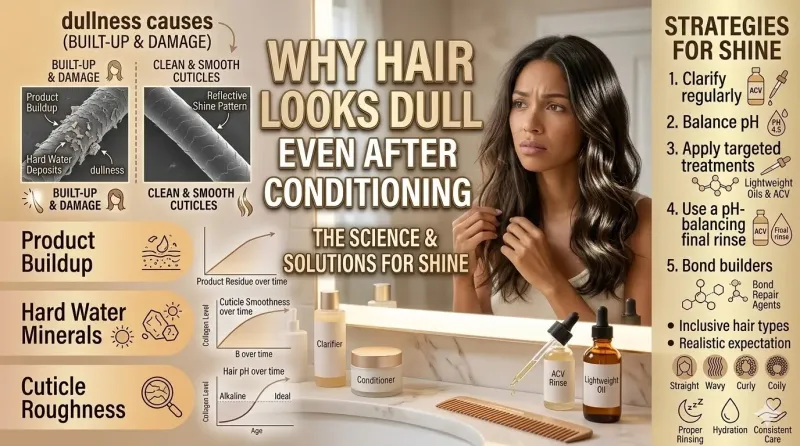
Understanding Hair Shine The Science of Light Reflection
Before addressing why hair looks dull despite conditioning, it's essential to understand what creates shine in the first place. Hair shine isn't about "moisture" alone—it's a physical phenomenon rooted in light reflection.
How Healthy Hair Reflects Light
1. Cuticle Alignment- Healthy hair has a smooth, tightly layered cuticle (the outermost scale-like layer)- When cuticles lie flat and aligned, light reflects uniformly off the surface = visible shine- When cuticles are raised, rough, or damaged, light scatters in multiple directions = dull, matte appearance
2. Surface Smoothness- A smooth hair shaft allows light to bounce cleanly off the surface- Roughness from damage, buildup, or dryness disrupts this reflection
3. Natural Lipid Layer- Sebum (natural scalp oil) travels down the hair shaft, providing a subtle, healthy sheen- Over-washing, harsh cleansers, or scalp conditions can disrupt this natural coating
4. Internal Light Transmission- Healthy hair allows some light to penetrate and reflect from within the cortex- Damage, porosity changes, or chemical treatments can alter this internal reflection
Conditioning's Role in Shine:Conditioners are designed to:- Smooth the cuticle with cationic surfactants that bind to negatively charged hair- Add lightweight emollients that enhance surface smoothness- Reduce friction between strands, minimizing mechanical damage- Seal in moisture to maintain flexibility and reduce breakage
But conditioning alone doesn't guarantee shine. If underlying issues aren't addressed, even the best conditioner may not deliver the radiance you expect.
Why Hair Looks Dull Even After Conditioning 7 Common Causes
Cause 1 Product Buildup Masking Shine
The Problem:Over time, residues from shampoos, conditioners, styling products, and even hard water minerals accumulate on the hair shaft. This buildup:- Creates a cloudy film that scatters light instead of reflecting it- Weighs hair down, reducing natural movement and bounce- Blocks beneficial ingredients from penetrating the hair shaft
Signs You Have Buildup:- Hair feels coated, sticky, or "waxy" even after washing- Products don't lather or absorb as well as they used to- Hair looks dull despite using shine-enhancing products- Scalp feels itchy or congested
Common Buildup Culprits:- Silicones (especially non-water-soluble types like dimethicone)- Heavy butters and oils that don't fully rinse- Cationic polymers in conditioners that accumulate over time- Hard water minerals (calcium, magnesium) that bind to hair- Dry shampoo, texturizing sprays, and styling product residue
The Solution: Strategic Clarifying- Use a clarifying shampoo once every 1-4 weeks (frequency depends on product use and water quality)- Look for formulas with gentle surfactants (cocamidopropyl betaine, decyl glucoside) plus chelating agents (EDTA, phytic acid) to remove minerals- Follow with a lightweight, pH-balanced conditioner to restore smoothness without adding heavy residue- For natural options: Apple cider vinegar rinse (1 part ACV to 3 parts water) helps dissolve buildup and restore pH
Pro Tip: If you use heavy silicones or styling products regularly, incorporate a clarifying step into your routine—don't wait for dullness to appear.
Cause 2 Hard Water Mineral Deposition
The Problem:Hard water contains high levels of dissolved minerals (calcium, magnesium, iron). When you wash hair in hard water:- Minerals bind to the hair shaft, creating a rough, opaque coating- This mineral film scatters light, causing dullness and rough texture- Minerals can also interfere with conditioner performance, reducing effectiveness
Signs Hard Water Is Affecting Your Hair:- Hair feels stiff, straw-like, or difficult to detangle after washing- White or grayish film on hair when wet- Conditioner doesn't seem to "take" or rinse cleanly- Dullness persists despite using high-quality products
The Solution: Chelation and Filtration- Use a chelating shampoo or treatment containing EDTA, citric acid, or phytic acid to bind and remove minerals- Install a shower filter designed to reduce mineral content (look for KDF, vitamin C, or activated carbon filters)- Rinse with bottled or filtered water as a final step if mineral buildup is severe- Follow mineral-removal treatments with a moisturizing conditioner to restore flexibility
Pro Tip: If you travel frequently or live in a known hard water area, keep a chelating treatment on hand for periodic reset washes.
Cause 3 Cuticle Damage Disrupting Light Reflection
The Problem:Physical or chemical damage lifts and erodes the cuticle layer, creating a rough surface that scatters light instead of reflecting it. Common causes:- Heat styling (flat irons, curling wands) without heat protectant- Chemical treatments (coloring, perming, relaxing) that alter hair structure- Mechanical damage (rough brushing, tight hairstyles, towel friction)- Environmental stressors (UV exposure, pollution, chlorine)
Signs of Cuticle Damage:- Hair feels rough or "catchy" when running fingers down the strand- Increased tangling and breakage- Dullness that doesn't improve with conditioning alone- Porosity issues: hair absorbs water quickly but dries unevenly
The Solution: Cuticle Repair and Protection- Use bond-building treatments (containing cysteamine, bis-aminopropyl diglycol dimaleate) to repair internal disulfide bonds- Apply lightweight protein treatments (hydrolyzed keratin, wheat protein) to temporarily fill cuticle gaps—use sparingly to avoid overload- Always use heat protectant sprays containing film-forming polymers before thermal styling- Minimize mechanical damage: use wide-tooth combs on wet hair, microfiber towels or cotton T-shirts for drying- Protect hair from UV exposure with hats or UV-protective hair products
Pro Tip: Damaged cuticles can't be "glued back" permanently, but consistent protective practices and targeted treatments can significantly improve light reflection and perceived shine.
Cause 4 Improper Conditioning Technique
The Problem:Even the best conditioner won't deliver shine if applied incorrectly. Common technique errors:- Applying conditioner to the scalp (can weigh down roots and cause buildup)- Not rinsing thoroughly (residue creates dull film)- Using too much product (over-conditioning leads to limp, coated hair)- Skipping the "cool rinse" (warm water keeps cuticles slightly raised; cool water helps seal them)
Signs Technique May Be the Issue:- Hair feels heavy or greasy at the roots despite conditioning only mid-lengths to ends- Dullness appears shortly after washing, suggesting incomplete rinsing- Shine improves temporarily after adjusting application method
The Solution: Optimize Your Conditioning Routine- Apply conditioner only from mid-lengths to ends; avoid the scalp unless you have very dry, coarse hair- Use a pea-to-quarter-sized amount depending on hair length and density—start small, add more if needed- Leave conditioner on for 2-5 minutes to allow ingredients to bind, then rinse thoroughly with cool water- Finish with a cool water rinse (last 30 seconds) to help seal cuticles and enhance light reflection- For extra shine: After rinsing, gently squeeze excess water with a microfiber towel, then apply a drop of lightweight oil (argan, squalane) to ends only
Pro Tip: If your hair is fine or low-porosity, try "squish to condish" (scrunching conditioner into wet hair) to enhance absorption without weighing hair down.
Cause 5 pH Imbalance Disrupting Cuticle Alignment
The Problem:Hair's natural pH is slightly acidic (~4.5-5.5). When products or water shift this balance:- Alkaline conditions (pH andgt;7) cause cuticles to lift and remain open, creating a rough surface- Open cuticles scatter light and increase friction, leading to dullness and tangling- Many conventional shampoos are alkaline; some conditioners don't adequately restore acidic pH
Signs pH May Be Off:- Hair feels rough or tangled even after conditioning- Dullness appears after switching to a new shampoo or conditioner- Color-treated hair fades faster or looks less vibrant
The Solution: Restore Acidic pH- Choose pH-balanced shampoos and conditioners (look for pH 4.5-5.5 on label or brand documentation)- Incorporate an acidic rinse: diluted apple cider vinegar (1:3 with water) or citric acid rinse after conditioning- Avoid alkaline clarifying shampoos too frequently; follow with pH-restoring conditioner- For color-treated hair: Use products specifically formulated to maintain acidic pH and protect color
Pro Tip: Test your tap water's pH with inexpensive test strips. If it's highly alkaline, a final rinse with bottled water or diluted ACV can make a noticeable difference in shine.
Cause 6 Mismatched Products for Your Hair Type
The Problem:Not all conditioners work for all hair types. Using the wrong formula can:- Weigh down fine hair, reducing volume and light reflection- Fail to provide enough emollience for coarse or high-porosity hair, leaving it dry and dull- Contain ingredients that build up on low-porosity hair, creating a dull film
Signs of Product Mismatch:- Hair feels limp, greasy, or coated despite using "lightweight" products- Hair remains dry, frizzy, or dull despite rich, moisturizing conditioners- Shine improves temporarily when switching product types
The Solution Match Conditioner to Hair Type
For Fine or Low-Porosity Hair:- Choose lightweight, liquid-based conditioners with hydrolyzed proteins or amino acids- Avoid heavy butters (shea, cocoa) and non-water-soluble silicones- Look for "volumizing" or "weightless" formulas- Apply sparingly; focus on ends only
For Coarse, Curly, or High-Porosity Hair:- Choose richer conditioners with emollients (cetyl alcohol, fatty alcohols) and humectants (glycerin, panthenol)- Look for curl-defining or moisture-repair formulas- Consider leave-in conditioners or light sealing oils for extra shine- Layer products: conditioner for hydration, light oil for seal and shine
For Color-Treated or Chemically Processed Hair:- Choose color-safe, sulfate-free formulas with UV filters and antioxidants- Look for bond-building or protein-supporting ingredients- Avoid harsh clarifying too frequently; use gentle chelating alternatives
Pro Tip: When trying new products, patch test on a small section first. Shine improvements should be noticeable within 1-3 uses if the product is well-matched.
Cause 7 Scalp Health Affecting Hair Shine
The Problem:Shine starts at the scalp. If your scalp isn't healthy:- Sebum production may be imbalanced (too little = dry, dull hair; too much = greasy roots with dull lengths)- Inflammation or buildup can impair healthy hair growth and cuticle formation- Poor circulation reduces nutrient delivery to hair follicles
Signs Scalp Health May Be a Factor:- Scalp feels itchy, flaky, or congested- Hair at the roots looks dull or greasy while ends are dry- New growth appears less shiny than older hair
The Solution: Support Scalp Health- Use a gentle, pH-balanced shampoo that cleanses without stripping- Incorporate scalp exfoliation 1x/week with salicylic acid or gentle physical exfoliants- Massage scalp gently during washing to stimulate circulation- Avoid heavy oils or butters directly on the scalp unless treating specific dryness- Stay hydrated and maintain balanced nutrition (protein, omega-3s, biotin, zinc support healthy hair growth)
Pro Tip: If you suspect scalp conditions (seborrheic dermatitis, psoriasis), consult a dermatologist. Treating the scalp often improves hair shine more effectively than topical hair products alone.
A Diagnostic Framework Identify Your Dullness Cause
Not sure which factor is affecting your hair? Use this quick assessment
Step 1: Evaluate Timing- Dullness appears immediately after washing? → Likely rinsing technique, pH imbalance, or product mismatch- Dullness builds over several days? → Likely buildup or hard water minerals- Dullness is constant regardless of wash day? → Likely cuticle damage or scalp health
Step 2: Assess Texture- Hair feels coated, sticky, or heavy? → Buildup or over-conditioning- Hair feels rough, dry, or tangled? → Cuticle damage, hard water, or product mismatch- Hair feels normal but looks dull? → pH imbalance or light reflection issues
Step 3: Consider Context- Recent travel, new water source, or product change? → Hard water or product mismatch- Frequent heat styling, coloring, or chemical treatments? → Cuticle damage- Fine, low-porosity, or color-treated hair? → Product mismatch likely
Step 4: Test Solutions- Try a clarifying wash: If shine improves, buildup or minerals were likely culprits- Try an acidic rinse: If shine improves, pH imbalance was likely a factor- Try a bond-building treatment: If shine improves, cuticle damage was likely involved
Evidence-Based Solutions for Restoring Shine
Once you've identified likely causes, implement these targeted strategies
Strategy 1: The Clarifying Reset (For Buildup or Hard Water)- Use a chelating clarifying shampoo once every 1-4 weeks- Follow with a lightweight, pH-balanced conditioner- Finish with a cool water rinse to seal cuticles- Optional: Apple cider vinegar rinse (1:3 with water) after conditioning for extra shine
Strategy 2: The pH Restoration Protocol (For Cuticle Alignment)- Switch to pH-balanced shampoo and conditioner (4.5-5.5)- Add a weekly acidic rinse: diluted ACV or citric acid solution- Avoid alkaline products (many clarifying shampoos, baking soda treatments)- Test water pH; use filtered water rinse if tap water is highly alkaline
Strategy 3: The Cuticle Repair Routine (For Damage-Related Dullness)- Incorporate bond-building treatments monthly (or as directed)- Use lightweight protein treatments sparingly (every 2-4 weeks) to avoid overload- Always apply heat protectant before thermal styling- Minimize mechanical damage: wide-tooth comb, microfiber drying, loose hairstyles
Strategy 4: The Product Matching Method (For Type-Specific Dullness)- Audit your current products: Do they match your hair's porosity, density, and needs?- Patch test new products before full application- Layer strategically: cleanse → condition → lightweight seal (if needed)- Adjust frequency: Fine hair may need less conditioner; coarse hair may benefit from leave-ins
Strategy 5: The Scalp-First Approach (For Root-to-Tip Shine)- Cleanse scalp gently but thoroughly; avoid heavy products on roots- Exfoliate scalp 1x/week to remove buildup and support healthy growth- Massage scalp during washing to stimulate circulation- Address underlying conditions with professional guidance if needed
A Sample Shine-Restoring Routine by Hair Concern
For Buildup-Related Dullness:Weekly:1. Clarifying shampoo with chelating agents (EDTA, phytic acid)2. Lightweight, pH-balanced conditioner applied mid-lengths to ends3. Cool water final rinse to seal cuticles4. Optional: ACV rinse (1:3) after conditioning for extra shine
Daily/Maintenance:- Use sulfate-free, pH-balanced shampoo for regular washes- Apply conditioner sparingly; rinse thoroughly- Avoid heavy styling products; opt for lightweight serums if needed
For Hard Water Dullness:Weekly:1. Chelating treatment shampoo to remove mineral deposits2. Moisturizing conditioner to restore flexibility3. Final rinse with filtered or bottled water if possible
Ongoing:- Install a shower filter to reduce mineral exposure- Use a leave-in conditioner with chelating ingredients for ongoing protection- Clarify monthly to prevent reaccumulation
For Cuticle Damage Dullness:Bi-Weekly:1. Bond-building treatment per product instructions2. Lightweight protein treatment (if hair feels porous or weak)3. Deep conditioning with emollients to smooth surface
Daily:- Always use heat protectant before thermal styling- Apply lightweight oil to ends for shine and protection- Minimize mechanical stress: gentle detangling, microfiber drying
For Fine or Low-Porosity Hair Dullness:Every Wash:1. Lightweight, liquid-based conditioner applied sparingly to ends2. "Squish to condish" technique to enhance absorption3. Cool water rinse to seal cuticles without weighing hair down
Avoid:- Heavy butters, non-water-soluble silicones, or thick creams- Over-conditioning: start with less product, add only if needed- Heavy oils on fine hair; opt for squalane or argan oil sparingly on ends only
For Coarse, Curly, or High-Porosity Hair Dullness:Every Wash:1. Rich, emollient-rich conditioner applied generously to mid-lengths and ends2. Leave-in conditioner or light sealing oil for extra moisture and shine3. Cool water rinse to enhance cuticle alignment
Enhance:- Layer products: conditioner for hydration, light oil for seal and shine- Use a microfiber towel or cotton T-shirt to dry without friction- Protect hair at night with silk/satin pillowcase or bonnet
Realistic Expectations Timelines for Shine Restoration
Restoring shine isn't instantaneous—it requires consistency and patience. Here's what to expect
Short-Term (1-2 Weeks):- Clarifying or pH-restoring treatments may show immediate improvement in light reflection- Hair may feel cleaner, lighter, and more responsive to products- Dullness from buildup or mineral deposits often improves fastest
Medium-Term (3-6 Weeks):- Cuticle repair treatments begin to show visible improvement in smoothness and shine- Consistent technique adjustments (cool rinses, proper application) compound benefits- Scalp health improvements support healthier new growth
Long-Term (2-3+ Months):- Damaged hair gradually improves with consistent protective practices- Product matching and routine optimization yield sustained radiance- New growth reflects improved scalp health and care habits
Factors Influencing Your Timeline:- Severity of damage or buildup: More significant issues take longer to resolve- Hair type and porosity: High-porosity hair may show faster improvement with moisture; low-porosity may need more time for product absorption- Consistency: Daily habits (heat protection, gentle handling) matter more than occasional intensive treatments- Underlying health: Nutrition, hydration, and hormonal balance influence hair quality from within
Common Mistakes That Perpetuate Dullness
Even with good intentions, certain habits can keep hair looking dull
Mistake 1: Over-ClarifyingWhy it backfires: Clarifying too frequently strips natural lipids, leading to dryness, cuticle damage, and paradoxical dullness.Fix: Limit clarifying to once every 1-4 weeks based on product use and water quality. Follow with moisturizing conditioner.
Mistake 2: Using Heavy Products on Fine HairWhy it backfires: Rich conditioners, butters, or oils weigh down fine strands, reducing volume and light reflection.Fix: Choose lightweight, liquid-based formulas; apply sparingly to ends only.
Mistake 3: Skipping the Cool RinseWhy it backfires: Warm water keeps cuticles slightly raised; without a cool final rinse, cuticles remain open, scattering light.Fix: Always finish with 30 seconds of cool water to help seal cuticles and enhance shine.
Mistake 4: Ignoring Water QualityWhy it backfires: Hard water minerals accumulate over time, creating a dulling film that conditioners can't fully address.Fix: Use chelating treatments periodically; consider a shower filter for ongoing protection.
Mistake 5: Expecting One Product to Fix EverythingWhy it backfires: Dullness often has multiple contributing factors; no single product addresses buildup, damage, pH, and scalp health simultaneously.Fix: Take a holistic approach: clarify when needed, match products to hair type, protect from damage, and support scalp health.
The Mindset Shift Shine as a Reflection of Overall Hair Health
Dull hair isn't a personal failure—it's valuable feedback about your hair's current needs. The goal isn't to achieve "perfect" shine but to cultivate hair that looks and feels healthy, resilient, and authentically yours.
Embrace These Principles:- Progress over perfection: Small, consistent improvements compound into visible radiance- Prevention is powerful: Protecting hair from damage is more efficient than repairing it later- Individuality matters: Your hair's shine will look different based on texture, color, and type—and that's beautiful- Holistic care yields best results: Topical products work best alongside nutrition, hydration, and gentle handling
Practice Hair-Positive Self-Talk:- Instead of "My hair never looks shiny," try "I'm learning what my hair needs to look and feel its best"- Celebrate non-appearance wins: consistent heat protection, gentle detangling, trying a new technique- Remember: healthy hair at any texture reflects self-care, not just genetics
Build a Supportive Environment:- Share your journey with trusted friends or communities; you're not alone- Limit exposure to filtered, idealized imagery that fuels unrealistic expectations- Focus on health and function: hair that feels strong and manageable, not just "shiny"
When to Consult a Professional
While most dullness concerns improve with at-home care, professional guidance can accelerate results or address complex cases.
Consult a Trichologist or Dermatologist If:- Dullness persists despite consistent, targeted care for 8-12 weeks- You notice unusual hair loss, scalp irritation, or texture changes- You have underlying health conditions that may affect hair (thyroid disorders, nutritional deficiencies)- You're considering chemical treatments and want to minimize damage risk
A professional can:- Assess scalp health and hair quality with specialized tools- Recommend medical-grade treatments or supplements if needed- Provide personalized product recommendations based on your hair's unique needs- Monitor progress and adjust strategies as your hair responds
Conclusion Radiance Through Understanding and Care
Hair that looks dull despite conditioning isn't broken—it's communicating. By understanding the science of shine, diagnosing the root causes of dullness, and implementing targeted, evidence-based solutions, you can restore the healthy radiance your hair deserves.
Remember:- Shine starts with cuticle alignment: Smooth, sealed cuticles reflect light beautifully- Buildup and minerals mask shine: Clarify strategically to reveal your hair's natural luster- pH matters: Acidic conditions help cuticles lie flat for optimal light reflection- Match products to your hair type: One size does not fit all in hair care- Scalp health influences hair shine: Support your scalp to support your strands- Consistency compounds: Small, daily habits create meaningful change over time
Start where you are. Audit your current routine. Identify one change to make this week—perhaps adding a clarifying wash, trying a cool final rinse, or switching to a pH-balanced conditioner. Notice how your hair responds. Build from there.
Your hair tells a story of resilience, adaptation, and the quiet power of showing up for yourself. With informed care and patience, you can cultivate hair that not only looks shiny but feels strong, healthy, and authentically yours.
For evidence-based hair care resources, personalized guidance, and expert support tailored to restoring shine and addressing dullness, explore trusted platforms that prioritize science, transparency, and individualized care. Your journey to radiant, healthy hair starts with one intentional choice at a time.
For thoughtfully curated shine-enhancing formulations, clarifying treatments, and hair care essentials designed to address dullness while respecting diverse hair types and concerns, discover trusted options at TrustShopBD (www.trustshopbd.com). Each selection is chosen to support your journey toward luminous, healthy hair while honoring your hair's unique needs and your commitment to informed, compassionate self-care.