

How to Invest in the Mirsarai Economic Zone: A Foreigner's Guide to Land Allocation and Industrial Real Estate in Bangladesh
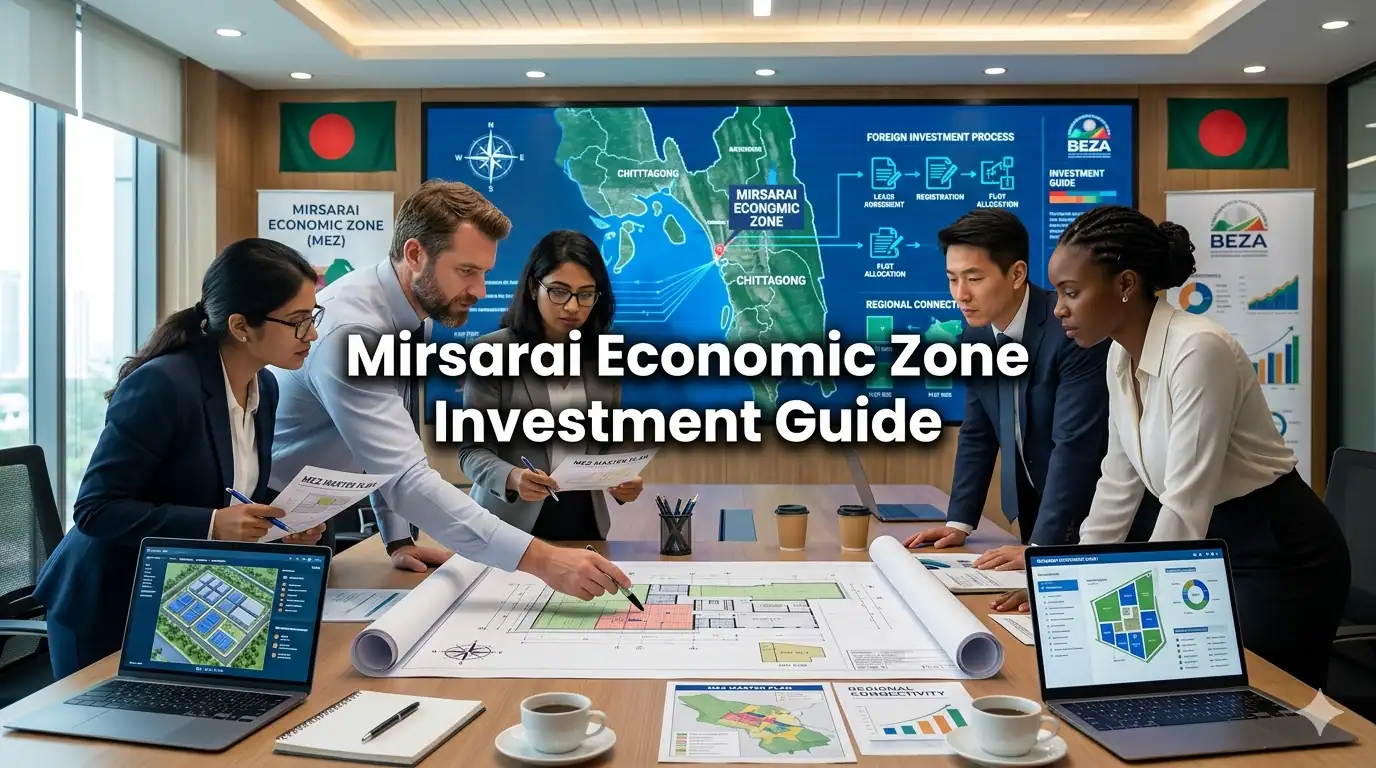
Foreign investors seeking opportunities in South Asia increasingly look to Bangladesh's Mirsarai Economic Zone (also spelled Mirsharai or Mirersharai) — a strategic industrial hub in Chattogram offering land allocation, tax incentives, and export-oriented infrastructure. However, navigating real estate investment in Bangladesh as a foreigner requires understanding unique legal frameworks, lease-based ownership models, and the role of government authorities like BEZA (Bangladesh Economic Zones Authority) and BEPZA (Bangladesh Export Processing Zones Authority).
Unlike residential property markets where foreign ownership is heavily restricted, economic zones in Bangladesh operate under special regulations designed to attract foreign direct investment (FDI). In the Mirsarai Economic Zone, foreigners typically cannot purchase land outright but can secure long-term leaseholds for industrial, commercial, or mixed-use development through structured allocation processes.
In this comprehensive, expert-level guide, we'll decode the legal framework for foreign investment in the Mirsarai Economic Zone, explain the step-by-step process for securing land allocation, outline financial requirements and incentives, and highlight critical compliance considerations. Whether you're a manufacturer, logistics operator, or developer evaluating opportunities in Bangladesh's fastest-growing economic corridor, you'll learn how to navigate the system effectively and mitigate risks.
Understanding the Mirsarai Economic Zone
Short answer: The Mirsarai Economic Zone is a large-scale, government-backed industrial development in Mirsarai Upazila, Chattogram, Bangladesh, managed by BEZA and BEPZA to attract domestic and foreign investment through allocated plots, infrastructure, and fiscal incentives.
Zone Overview
Location & Scale:
- Located in Mirsarai Upazila, Chattogram Division, on the bank of the Sandwip Channel [[3]]
- Part of the broader National Special Economic Zone (formerly Bangabandhu Sheikh Mujib Shilpa Nagar) [[4]]
- BEZA allocated approximately 1,150 acres to BEPZA for the BEPZA Economic Zone component [[1]]
- Planned capacity: ~850 industrial plots targeting ~350 industrial units and $4.5 billion in investment [[1]]
Strategic Advantages:
- Proximity to Chattogram Port (Bangladesh's primary seaport) and Dhaka-Chattogram highway
- Access to regional markets: Bangladesh, Eastern India, and Southwest China [[5]]
- Designed as a "greenfield" zone with modern infrastructure: power, water, waste management, logistics [[2]]
- Special regulatory framework with one-stop services for investors [[22]]
Key Managing Authorities
Bangladesh Economic Zones Authority (BEZA):
- Established under the Bangladesh Economic Zones Act, 2010 [[31]]
- Mandated to establish, license, operate, and manage economic zones [[23]]
- Provides one-stop services: investment approval, utility connections, customs clearance [[22]]
Bangladesh Export Processing Zones Authority (BEPZA):
- Manages Export Processing Zones (EPZs) and now developing the BEPZA Economic Zone in Mirsarai [[1]]
- Offers similar incentives to EPZs: tax holidays, duty-free imports, simplified labor regulations
- Coordinates with BEZA on land allocation and investor services
Foreign Investment Rules: What Foreigners Can and Cannot Do
Short answer: Foreigners cannot own land freehold in Bangladesh, but economic zones permit long-term leaseholds (typically 30-99 years) for industrial/commercial use under the Bangladesh Economic Zones Act, 2010 and Foreign Private Investment (Promotion & Protection) Act, 1980.
General Property Ownership Restrictions in Bangladesh
Standard Rules (Outside Economic Zones):
- Foreign individuals: Generally restricted to purchasing apartments/flats only, not land [[33]]
- Land ownership cap: Typically limited to 0.25 acres in urban areas for foreigners [[29]]
- Security-sensitive areas (border regions, military zones) are off-limits for foreign investment [[29]]
- Requires approval from Bangladesh Investment Development Authority (BIDA) and Ministry of Home Affairs
Special Provisions for Economic Zones:
- Economic zones are designated areas where foreign investment rules are relaxed to attract FDI [[29]]
- Foreign companies can lease industrial plots for 30-99 years under the Bangladesh Economic Zones Act, 2010 [[31]]
- Leasehold rights are transferable and can be used as collateral with regulatory approval
- Investors benefit from one-stop services, tax holidays, and duty-free import of capital machinery [[22]]
Legal Framework Governing Foreign Investment
Key Legislation:
- Bangladesh Economic Zones Act, 2010: Establishes legal basis for zone creation, land allocation, and investor incentives [[31]]
- Foreign Private Investment (Promotion & Protection) Act, 1980: Guarantees protection against expropriation, allows repatriation of profits [[37]]
- Bangladesh Export Processing Zones Authority Act, 1980: Governs EPZ operations and investor privileges
- Public-Private Partnership Act, 2015: Enables PPP models for zone development [[17]]
Investment Protections:
- 100% foreign equity ownership permitted in most sectors [[38]]
- Guarantee against nationalization without fair compensation
- Repatriation of capital, profits, and dividends allowed through banking channels
- Dispute resolution through international arbitration (ICSID, UNCITRAL)
Step-by-Step Guide: Securing Land Allocation in Mirsarai Economic Zone
Short answer: Foreign investors secure land in Mirsarai through a structured process: pre-qualification, application to BEZA/BEPZA, feasibility review, lease agreement negotiation, and regulatory approvals — typically taking 3-9 months.
Phase 1: Pre-Application Preparation (Weeks 1-4)
1. Define Investment Scope:
- Identify sector: manufacturing, logistics, warehousing, mixed-use
- Estimate land requirement: plot sizes in Mirsarai typically range from 0.5 to 10+ acres depending on project scale [[1]]
- Prepare preliminary business plan: investment amount, job creation, export targets
2. Engage Local Advisors:
- Retain a Bangladeshi law firm experienced in FDI and economic zone regulations
- Consult with BEZA's One Stop Service (OSS) center for preliminary guidance [[22]]
- Consider engaging a local partner for navigation of bureaucratic processes (optional but recommended)
3. Pre-Qualification Check:
- Verify eligibility: foreign-registered company with minimum paid-up capital (varies by sector)
- Ensure no adverse records with Bangladesh Bank or BIDA
- Prepare corporate documents: certificate of incorporation, board resolution, financial statements
Phase 2: Application & Evaluation (Weeks 5-12)
1. Submit Formal Application:
- Apply through BEZA's online portal or OSS center with required documents:
- Investment proposal with technical and financial details
- Environmental Impact Assessment (EIA) screening report
- Proof of financial capability (bank comfort letter, audited statements)
- Passport copies of directors/shareholders
2. Feasibility Review:
- BEZA/BEPZA evaluates project alignment with zone master plan and national priorities
- Technical committee assesses land requirement, utility needs, and infrastructure compatibility
- Environmental clearance may be required depending on project type
3. Plot Allocation Offer:
- If approved, investor receives a Letter of Intent (LOI) specifying:
- Plot number, size, location within zone
- Lease term (typically 30-99 years)
- Annual rent rate (quoted in USD per square meter) [[12]]
- Development timeline and performance obligations
Phase 3: Agreement & Registration (Weeks 13-24+)
1. Lease Agreement Execution:
- Negotiate and sign the Land Lease Agreement with BEZA/BEPZA
- Key terms: rent escalation clauses, permitted uses, development deadlines, termination conditions
- Pay initial lease premium (typically 10-30% of total lease value)
2. Regulatory Approvals:
- Obtain BIDA registration for foreign investment
- Secure environmental clearance from Department of Environment (if required)
- Register lease with relevant land authorities (leasehold registration, not freehold)
3. Commence Development:
- Submit detailed construction plans for zone authority approval
- Begin infrastructure development per agreed timeline
- Access zone utilities: power, water, gas, telecommunications via zone management
Financial Considerations: Costs, Incentives, and Repatriation
Short answer: Land lease costs in Mirsarai are quoted in USD per square meter annually; investors benefit from tax holidays, duty-free imports, and profit repatriation — but must budget for development costs, compliance, and ongoing lease payments.
Land Lease Costs
Pricing Structure:
- Rent is typically quoted in USD per square meter per year [[12]]
- Indicative rates (subject to change): $2-$15/sq.m./year depending on location within zone and sector priority
- Payment terms: Annual advance payment, with escalation clauses (e.g., 5% every 5 years)
- Security deposit: Usually equivalent to 6-12 months' rent
Additional Costs:
- Development charges: Infrastructure contribution fees for roads, utilities, common facilities
- Utility connection fees: Power, water, gas connections billed separately
- Professional fees: Legal, architectural, engineering, environmental consulting
- Compliance costs: Licensing, inspections, reporting obligations
Fiscal Incentives for Foreign Investors
Tax Benefits:
- Tax Holiday: Up to 10 years income tax exemption for export-oriented industries
- Duty-Free Imports: Capital machinery, raw materials, and components imported for production
- VAT Exemptions: On local procurement of goods/services for export production
- Dividend Tax Exemption: For foreign shareholders during tax holiday period
Operational Incentives:
- One-stop services: Single-window clearance for permits, utilities, customs
- Flexible labor regulations: Simplified hiring/firing procedures within zones
- 100% foreign ownership permitted without local partner requirement [[38]]
- Repatriation of profits, capital, and royalties through banking channels
Profit Repatriation Process
Eligible Flows:
- Dividends after tax
- Capital gains on lease transfer (with approval)
- Royalties, technical fees, and management fees (subject to withholding tax)
- Proceeds from sale of assets (with regulatory clearance)
Process:
- Obtain tax clearance certificate from National Board of Revenue (NBR)
- Submit repatriation request to Bangladesh Bank through authorized dealer bank
- Provide supporting documents: board resolution, audited financials, tax certificates
- Bank processes transfer in convertible foreign currency (USD, EUR, GBP)
Development Models: Direct Lease vs. Master Developer Partnerships
Short answer: Foreign investors can either lease plots directly from BEZA/BEPZA or partner with an International Master Developer under a PPP framework — each model offers different risk/reward profiles.
Direct Lease Model
How It Works:
- Investor applies directly to BEZA/BEPZA for plot allocation
- Signs lease agreement with zone authority
- Responsible for own infrastructure development within plot boundaries
- Zone authority provides external infrastructure: roads, power substations, water mains
Pros:
- Direct relationship with government authority
- Greater control over design and development timeline
- Potentially lower long-term costs (no master developer margin)
Cons:
- Higher upfront development responsibility and capital requirement
- More complex permitting and coordination with multiple agencies
- Slower initial setup due to bureaucratic processes
Best For: Large-scale manufacturers, logistics operators, or developers with local experience and capital capacity.
Master Developer (PPP) Model
How It Works:
- BEZA selects an International Master Developer via tender to develop a sub-zone [[24]]
- Master Developer builds infrastructure, utilities, and sometimes ready-built factories
- End investors lease plots or facilities from the Master Developer
- Master Developer manages zone operations, maintenance, and investor services
Pros:
- Turnkey solution: faster occupancy with pre-developed infrastructure
- Single point of contact for utilities, security, and administrative services
- Reduced regulatory burden: Master Developer handles zone-level compliance
- Potential for ready-built factory options (lower entry barrier)
Cons:
- Higher lease rates (Master Developer margin included)
- Less control over infrastructure specifications and timeline
- Dependency on Master Developer's performance and financial health
Best For: SMEs, first-time investors in Bangladesh, or companies seeking rapid market entry with minimal setup complexity.
Risk Management and Compliance Essentials
Short answer: Successful investment in Mirsarai requires managing legal, regulatory, operational, and political risks through due diligence, local partnerships, insurance, and proactive compliance.
Key Risk Categories
Legal & Regulatory Risk:
- Challenge: Evolving regulations, bureaucratic delays, interpretation inconsistencies
- Mitigation: Engage experienced local counsel; maintain open communication with BEZA OSS; document all approvals
Land Title & Lease Risk:
- Challenge: Leasehold (not freehold) ownership; potential disputes over boundaries or terms
- Mitigation: Conduct thorough due diligence on plot status; ensure lease is registered; include dispute resolution clauses
Infrastructure & Utility Risk:
- Challenge: Delays in power, water, or gas connections; reliability concerns
- Mitigation: Negotiate service level agreements; budget for backup systems (generators, water storage); monitor zone development progress
Political & Macroeconomic Risk:
- Challenge: Policy changes, currency volatility, geopolitical tensions
- Mitigation: Structure investments with repatriation protections; hedge currency exposure; maintain political risk insurance
Compliance Checklist for Foreign Investors
- ✓ Register investment with BIDA before capital inflow
- ✓ Obtain environmental clearance if project requires EIA
- ✓ Secure all construction permits from zone authority and local government
- ✓ Comply with labor laws: minimum wage, safety standards, worker registration
- ✓ Maintain accurate financial records for tax and repatriation purposes
- ✓ Submit periodic reports to BEZA/BEPZA as required by lease agreement
- ✓ Renew licenses and permits before expiration
Practical Tips for Foreign Investors
Short answer: Success in Mirsarai requires local knowledge, relationship building, patience with processes, and a long-term perspective — treat Bangladesh as a strategic partnership, not just a transaction.
Before You Apply
- Visit the Zone: Conduct a site visit to assess infrastructure progress, location advantages, and zone management responsiveness
- Network Locally: Attend BEZA/BIDA investment seminars; connect with existing zone investors for insights
- Understand Cultural Context: Business in Bangladesh relies on relationships; invest time in building trust with officials and partners
- Budget Realistically: Factor in time (6-12 months for setup) and contingency costs (15-25% buffer) beyond initial estimates
During Implementation
- Leverage One-Stop Services: Use BEZA's OSS center to streamline approvals; maintain a single point of contact
- Document Everything: Keep meticulous records of applications, approvals, payments, and communications
- Engage Local Talent: Hire Bangladeshi professionals for operations, compliance, and community relations
- Plan for Phased Development: Start with core infrastructure; expand as operations stabilize and market demand validates
Long-Term Success Factors
- Community Engagement: Invest in local workforce development and CSR initiatives to build social license to operate
- Adaptability: Bangladesh's regulatory environment evolves; stay informed and flexible in strategy
- Exit Planning: Understand lease transfer procedures early; structure agreements to preserve optionality
Frequently Asked Questions
Can a foreign individual (not a company) lease land in Mirsarai Economic Zone?
Short answer: Generally no. Land allocation in economic zones is typically available to registered corporate entities (foreign or domestic), not individual foreigners. Foreign individuals may invest through a locally or internationally registered company.
What is the minimum investment required to secure a plot?
Short answer: Minimum investment thresholds vary by sector and plot size but typically start around $500,000-$1 million for small industrial plots. BEZA evaluates proposals holistically based on job creation, export potential, and technology transfer, not just capital amount.
How long does the entire process take from application to occupancy?
Short answer: 6-18 months depending on project complexity, regulatory approvals, and infrastructure readiness. Simple lease allocations may take 3-6 months; greenfield developments with custom infrastructure can take 12-24 months.
Can I sublease my allocated plot to another investor?
Short answer: Subleasing typically requires prior written approval from BEZA/BEPZA and must comply with zone master plan and lease terms. Unauthorized subleasing may result in lease termination.
What happens at the end of the lease term?
Short answer: Lease agreements usually include renewal options subject to performance review and updated terms. Upon expiration without renewal, improvements may revert to the zone authority per agreement terms — negotiate renewal rights upfront.
Is financing available for foreign investors developing in Mirsarai?
Short answer: Local banks may provide project financing to foreign-invested enterprises with adequate collateral and cash flow projections. International development finance institutions (IFC, ADB) also support eligible projects. Engage lenders early in the planning process.
The Bottom Line: Strategic Patience Yields Rewards
Investing in the Mirsarai Economic Zone offers foreign businesses access to Bangladesh's strategic location, competitive labor costs, and growing export markets — but success requires navigating a distinct legal framework, building local relationships, and committing to long-term development.
Key Takeaways:
- Lease, Don't Own: Foreigners secure land through long-term leaseholds, not freehold ownership
- Work Through Official Channels: Engage BEZA/BEPZA One Stop Services for streamlined processing
- Choose Your Model Wisely: Direct lease offers control; Master Developer partnerships offer speed
- Factor Incentives Into ROI: Tax holidays and duty-free imports significantly improve project economics
- Compliance Is Non-Negotiable: Maintain meticulous records and proactive engagement with regulators
- Think Long-Term: Bangladesh rewards patient capital with growing market access and operational advantages
The Mirsarai Economic Zone represents a frontier opportunity for foreign investors willing to invest the time to understand Bangladesh's unique investment landscape. By combining thorough due diligence, local expertise, and strategic patience, businesses can secure valuable industrial real estate and position themselves for growth in one of South Asia's most dynamic economies.
Ready to explore Mirsarai? Start by contacting BEZA's One Stop Service Center, reviewing the latest prospectus for land allotment [[17]], and consulting with legal advisors experienced in Bangladesh FDI. The zone is actively seeking international partners — and with the right preparation, your investment can be part of Bangladesh's next chapter of industrial growth.


0 Comments